Can Powerful SEO Content Really Transform Business Growth? See 18 Real Examples That Prove It Can
May 7, 2026
Why Your Business Is Disappearing From Google, ChatGPT and AI Search — And What Don Draper Would Do About It
June 20, 2026
Search Has Changed — And Most Businesses Haven’t Caught Up Yet
A lot of companies still think search means one thing:
Ranking on Google.
That’s no longer the full picture.
Google still matters. Of course it does. But people now discover businesses through a mix of:
- traditional search
- AI-generated answers
- voice assistants
- conversational search
- AI recommendation engines
- mobile AI interfaces
In other words, search has fragmented.
Quietly at first.
Then all at once.
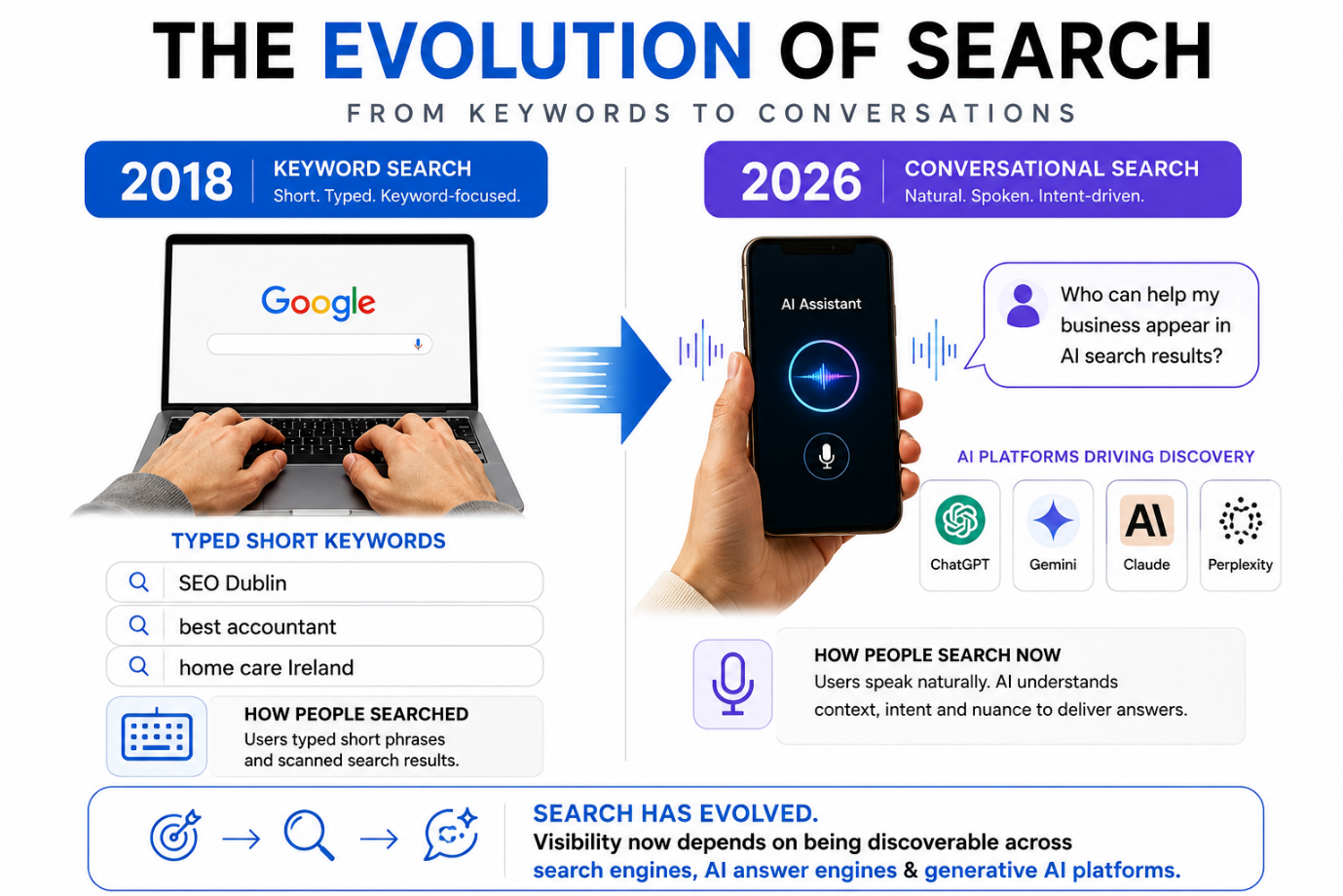
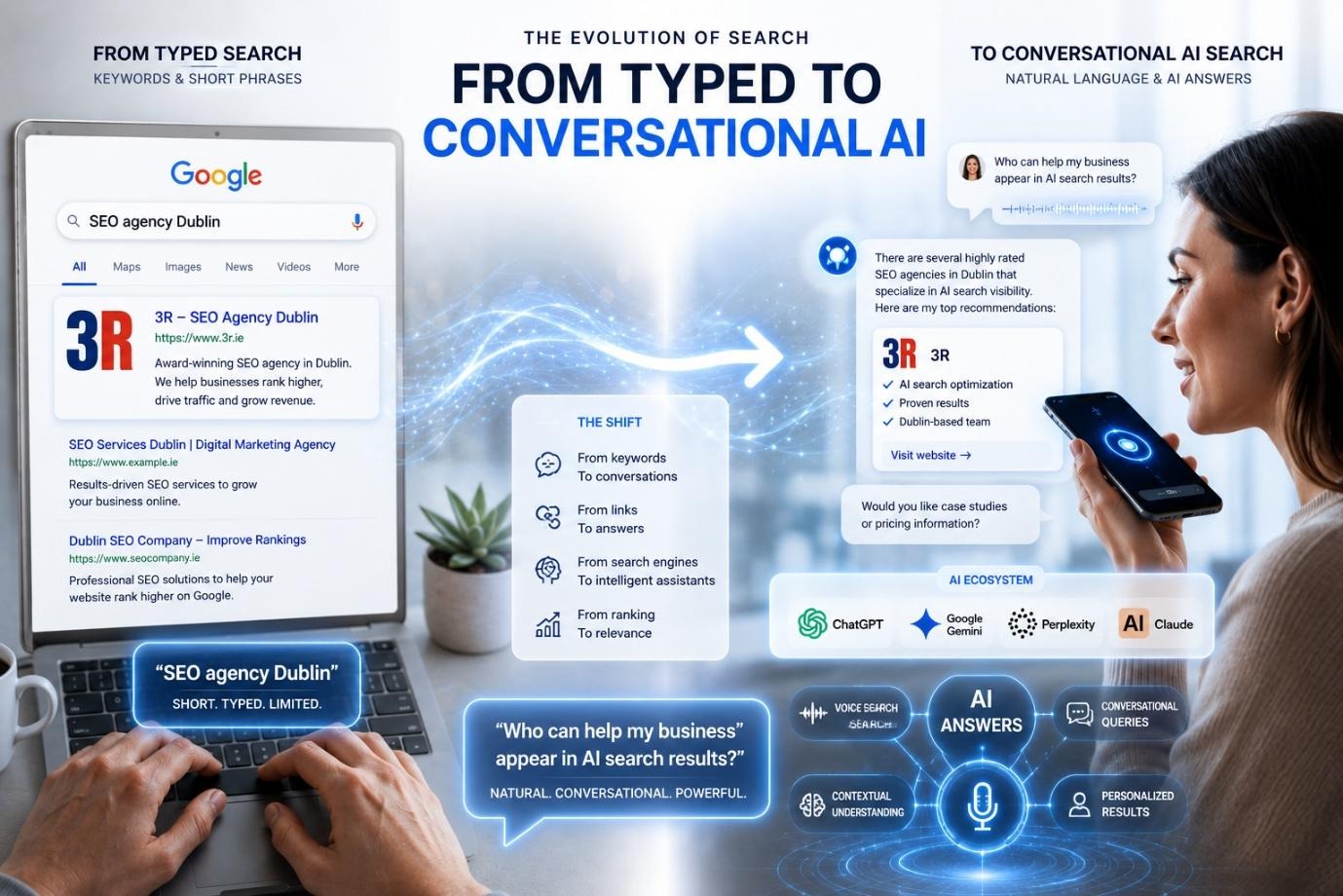
Three years ago, somebody might have typed:
“SEO Dublin”
Now they’re more likely to ask:
“Who can help my business appear in ChatGPT, Google and AI search results in Ireland?”
That single behavioural shift changes how content needs to be written, structured and understood online.
And most businesses are still optimising for the old internet.
SEO, AEO and GEO — What’s the Difference?
This is where confusion starts for a lot of people.
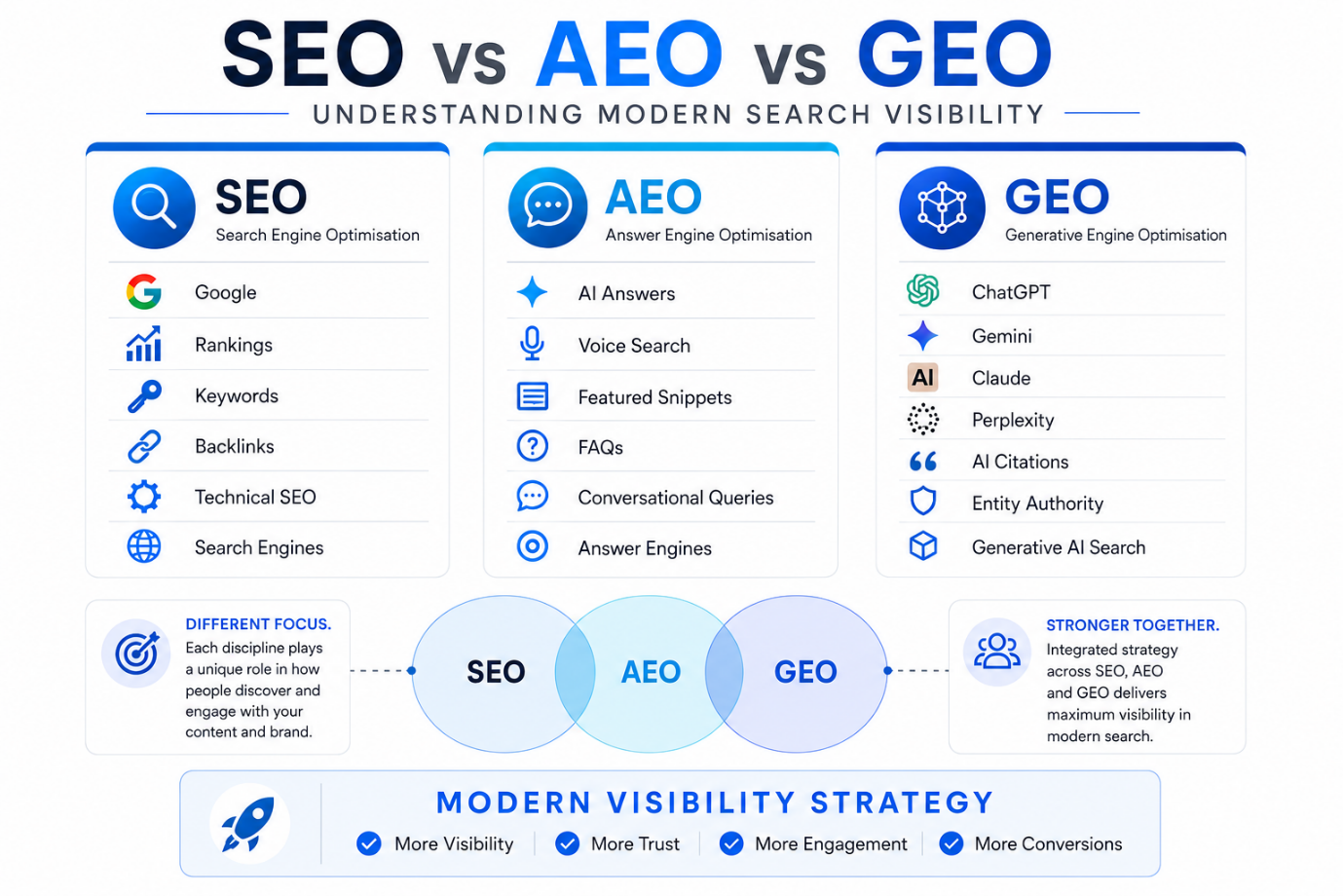
SEO, AEO and GEO are connected, but they are not the same thing.
Each one focuses on a different layer of visibility.
And right now, businesses increasingly need all three working together.
SEO — Search Engine Optimisation – Google Search
SEO is the traditional foundation.
It focuses on helping your website rank in search engines like:
- Bing
Classic SEO still includes:
- technical optimisation
- page structure
- internal linking
- metadata
- backlinks
- keyword targeting
- user experience
- topical authority
None of that disappeared because AI arrived.
But here’s the problem.
Ranking alone no longer guarantees visibility.
Google increasingly answers questions directly inside search results through:
- AI Overviews
- featured snippets
- knowledge panels
- instant answers
So a business can technically “rank” while receiving fewer clicks than before.
That’s one of the biggest shifts happening in search right now.
AEO — Answer Engine Optimisation – Voice Search
AEO stands for Answer Engine Optimisation.
This is about structuring content so platforms can easily extract and deliver answers.
Not just links.
Answers.
That includes:
- Google AI Overviews
- voice assistants
- Siri
- Alexa
- featured snippets
- conversational search interfaces
AEO works because modern users increasingly search in full questions rather than short keywords.
For example:
Old search behaviour:
“best accountant Dublin”
Modern search behaviour:
“Who’s the best accountant in Dublin for small business tax advice?”
That changes content strategy completely.
Strong AEO content usually includes:
- question-based headings
- concise explanations
- conversational phrasing
- clear structure
- semantic relevance
- FAQ-style formatting
In simple terms:
AEO helps machines understand the answer quickly.
GEO — Generative Engine Optimisation – AI Search
GEO is where search is heading fastest.
Generative Engine Optimisation focuses on helping AI systems:
- understand your brand
- trust your content
- reference your expertise
- cite your information
- surface your business inside AI-generated responses
This includes platforms like:
- ChatGPT
- Gemini
- Claude
- Perplexity
- DeepSeek
And this behaves very differently from traditional SEO.
AI engines don’t simply rank pages.
They interpret:
- authority
- consistency
- semantic relationships
- entity recognition
- contextual trust
- expertise signals
That means weak content becomes far easier to detect.
And generic AI-written articles are already becoming a major problem online.
The Internet Is Becoming Saturated with AI Content
This is the part many marketers still avoid discussing honestly.
The internet is now flooded with AI-generated material.
You can see it everywhere:
- repetitive blogs
- generic “thought leadership”
- rewritten summaries
- surface-level explainers
- content with no real experience behind it
Most of it sounds technically polished.
And most of it is forgettable.
That creates a serious problem for both search engines and AI systems.
Because they now need to determine:
what content is genuinely trustworthy?
That’s why Google’s E-E-A-T framework matters more than ever:
- Experience
- Expertise
- Authoritativeness
- Trustworthiness
Ironically, AI may end up increasing the value of genuinely human communication.
Not reducing it.

Why Humanised Content Now Matters for SEO, AEO and GEO
AI itself is not the issue.
Poor AI usage is.
There’s a massive difference between:
- using AI to support expertise
- using AI to imitate expertise
The second version is becoming painfully obvious online.
You see the same patterns repeatedly:
- overly polished wording
- repetitive sentence rhythm
- generic optimism
- safe opinions
- no commercial insight
- no lived experience
The article sounds clean.
But it doesn’t sound real.
And increasingly, that matters.
Because search engines and AI systems are both getting better at identifying:
- authentic expertise
- original insight
- topical depth
- trusted authority
- human perspective
That is exactly where businesses now need to differentiate themselves.
Voice Search and AI Dictation Are Changing Search Behaviour Completely
This shift is bigger than most businesses realise.
Typing creates compressed searches.
Speaking creates natural language.
That changes everything.
Someone typing might search:
“SEO agency Ireland”
But somebody using voice search is more likely to say:
“Who can help my business rank in Google and appear in ChatGPT answers?”
That creates:
- longer searches
- more conversational searches
- more contextual searches
- more intent-driven searches
And tools accelerating this behaviour include:
- Siri
- Google voice search
- AI assistants
- AI keyboards
- dictation tools like Wispr
- wearable devices
People no longer reduce themselves into robotic keyword phrases.
They simply ask naturally.
Which means content now needs to sound natural too.
This Is Where the 3R Framework Fits
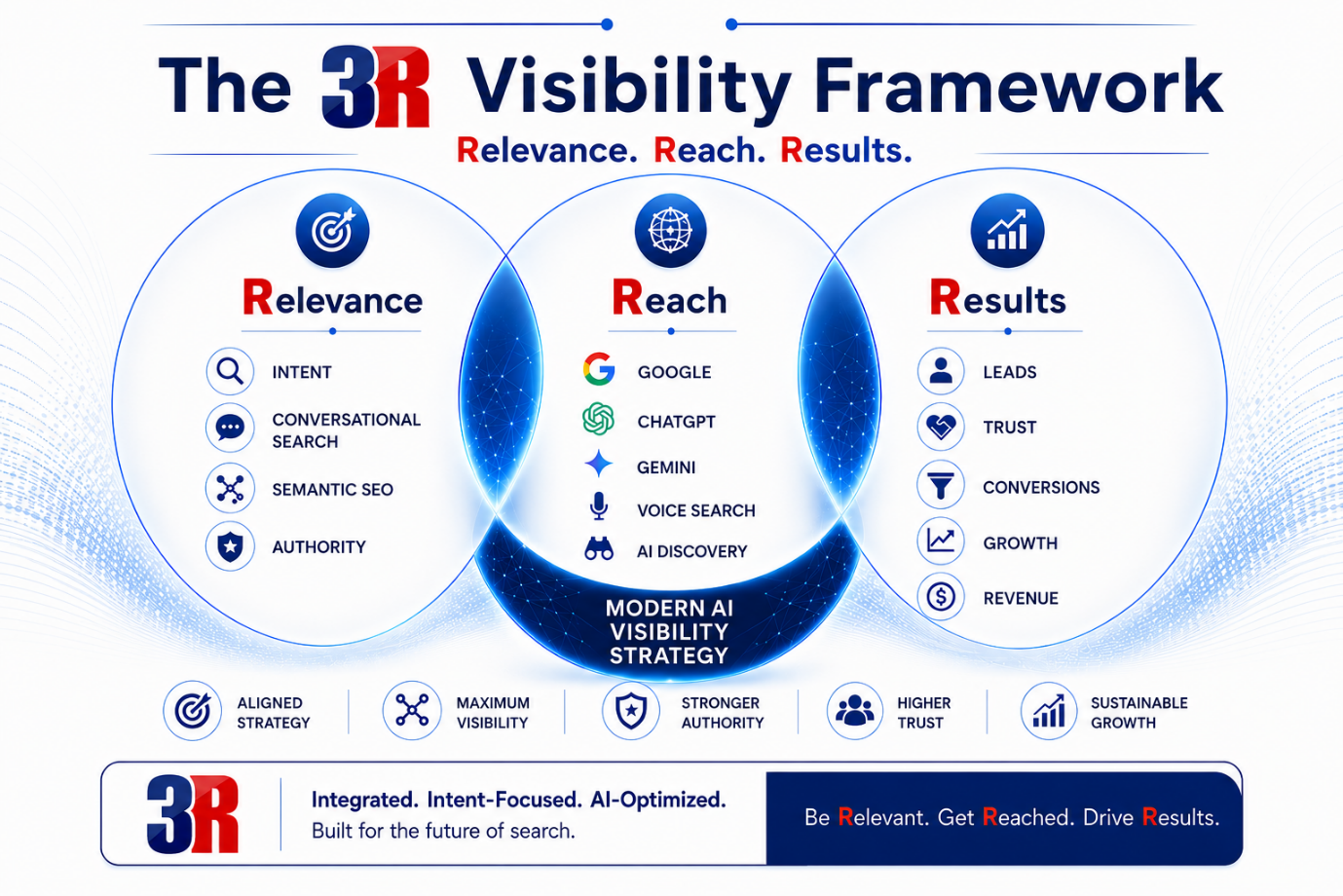
At 3R, the framework is intentionally simple:
Relevance
Reach
Results
Because modern visibility is no longer just about rankings.
It’s about discoverability across multiple systems simultaneously.
Relevance — Matching Real Search Intent
Relevance used to focus heavily on keywords.
Now it focuses on understanding intent.
AI systems increasingly evaluate:
- context
- meaning
- conversational alignment
- semantic relationships
- topical authority
Which means content has to genuinely answer real questions clearly.
Not just include keywords repeatedly.
This is one reason conversational content performs so strongly in both SEO and AEO environments.
Humans search conversationally now.
And AI interprets conversationally too.
Reach — Visibility Across Search and AI Platforms
Reach means being discoverable wherever people search.
That now includes:
- Bing
- ChatGPT
- Gemini
- Perplexity
- voice assistants
- AI recommendation systems
Modern visibility is multi-platform visibility.
The businesses that understand this early are going to build enormous competitive advantages over the next few years.
A lot of companies still haven’t realised how quickly user behaviour is changing.
Results — The Metric That Actually Matters
This is where many SEO conversations still lose touch with reality.
Traffic alone means very little.
Rankings alone mean very little.
Visibility without commercial outcomes is largely vanity.
What businesses actually care about is:
- enquiries
- leads
- conversions
- trust
- growth
- revenue
That’s the real purpose of SEO, AEO and GEO combined.
Not just appearing online.
But being chosen.
What Businesses Need to Do Now
The businesses that will dominate visibility in the next phase of the internet are probably not the businesses producing the most content.
They’ll be the businesses producing the most trusted content.
That means:
- clear expertise
- structured information
- conversational language
- entity authority
- original insight
- human experience
- AI-ready formatting
SEO still matters.
AEO matters more than many businesses realise.
And GEO is likely to become one of the defining visibility disciplines of the AI era.
Because search is no longer just about search engines.
It’s about being understood by machines, trusted by humans, and surfaced across every layer of modern discovery.
And businesses that fail to adapt to that shift are going to slowly lose visibility without fully understanding why.
Maybe now is the time for a search audit.