Why Your Business Is Disappearing From Google, ChatGPT and AI Search — And What Don Draper Would Do About It
June 20, 2026
ChatGPT Ads, AI Search and Irish Marketers: A 3R Perspective on Paid AI Visibility, B2C Growth and B2B Limits
July 16, 2026Why Your Business Is Disappearing from Google and AI Search — And How 3R Builds the Architecture to Bring It Back

What Is Changing in Google, ChatGPT and AI Search?
Traditional search is no longer just about ranking first on Google. AI Overviews, ChatGPT search, voice search and generative answers are changing how people find businesses, compare services and decide who to contact next.
For more than 20 years, we have watched businesses rise and fall on the strength of how well they communicate at the point of search. Not how clever their slogans are. Not how polished the brochure looks. How well they answer the question someone is already asking.
That question used to be short.
“Counsellor near me.”
“Driveway contractor Dublin.”
“SEO agency Ireland.”
Now the question is longer, more specific and often far more revealing.
“What counsellor near me works with anxiety and trauma?”
“Who is the best driveway contractor for a rural home in Kildare?”
“What Irish manufacturer can supply stainless steel parts quickly?”
The buyer has not changed as much as people think. They still want help. They still want reassurance. They still want to know who they can trust.
What has changed is the first layer of response. Google, ChatGPT, Gemini, Perplexity and voice assistants are beginning to answer before the user ever reaches your website.
That is uncomfortable for a lot of businesses. It should be.
If your website only contains broad service claims, generic copy and a few scattered keywords, AI has very little reason to send someone to you. It may summarise your market perfectly well and leave you out of the commercial journey altogether.
The old search game was about rankings. The new one is about being understood well enough to be recommended, trusted and chosen.
At 3R, we see this less as a technical shift and more as a communication audit. AI Search did not replace human communication. It exposed weak communication.
TL;DR — What Should Businesses Know About AI Search?
- AI Search is changing how people discover, compare and choose businesses.
- SEO still matters, but it now needs AEO, GEO, better content structure and stronger conversion thinking.
- 3R uses the same system to attract clients that we then build for those clients.
- Google Ads are useful as an accelerator, but SEO is the long-term asset.
- The goal is not just to be mentioned by AI, but to create an action gap that sends users to your website.
- 3R will build this pillar into an industry-by-industry content network, with new pillar support articles added every other week.
Why Did 3R Become a Search Agency Before AI Search Arrived?
3R became a search agency because clients found us through search before they wanted anything else. One prospect did not ask for sales consultancy; they asked how we got to the top of Google when they searched for help.
That phone call changed how we thought about the business.
We had been talking about sales and marketing consultancy. The market was telling us something more direct. It did not want a lecture about strategy. It wanted to know how to be found by the right people at the right time.
That is how search became central to 3R.
Not because SEO was trendy. Not because Google Ads were new. Not because ranking reports looked impressive in a monthly meeting.
Search mattered because it revealed intent. When someone searches properly, they are not browsing for entertainment. They are looking for a way forward. They are trying to understand their options. They are often closer to action than they realise.
We have seen businesses spend years chasing rankings while enquiries quietly declined. More often than not, the issue was not that they had no traffic. It was that the website did not connect the searcher’s problem to a clear next step.
That lesson still applies in AI Search.
The question has simply become more conversational. The search journey now begins with longer prompts, more context and a higher expectation that the answer will be useful straight away.
So the work has changed.
We are not just trying to get a business found. We are trying to make the business understandable enough that search engines, AI systems and actual human beings can all see when it is the right fit.
What Is the Recursive 3R Framework?
The recursive 3R framework means we use the same relevance, reach and results system to attract you that we then use to help you attract your customers.
The framework was not created first. The pattern came first.
Over time, we realised the same three things kept appearing in every strong search strategy.
A business had to be relevant to the right audience. It had to reach that audience through the right search channels. And it had to turn that attention into a real commercial result.
That became Relevance, Reach and Results.
The recursive part is simple enough. You find 3R because we have created content that speaks to a problem you already have. You are reading this because search, content and positioning have done their job.
Then we take the same approach and apply it to your business.
You become relevant to your audience in the same way we became relevant to you.
You reach your audience using the same search disciplines that allowed you to find us.
You convert that audience using the same commercial thinking that brought you closer to speaking with 3R.
The way you found 3R is the way your next best customer should find you.
That is not meant to sound clever. It is simply what we have seen work.
How Does Relevance Help Your Business Become the Right Answer?
Relevance is where most search strategies either work or quietly fail. In AI Search, vague websites lose ground because the search system needs to understand who the business helps, what problem it solves and why that matters to the person asking.
One of the biggest surprises for clients is discovering they were never really competing on keywords at all.
They were competing on interpretation.
Google had to interpret them. AI systems now have to interpret them. More importantly, their potential customers had to interpret them.
If a website says “professional service”, “tailored solutions” and “client-focused approach”, it may sound respectable, but it rarely tells the searcher enough. It does not say who the service is for, what problem it solves, what situation the client is in, or why this business is the safe choice.
That is where 3R starts.
We do not begin by asking, “What keywords do you want to rank for?”
We ask what the relationship is between the business, the audience and the decision being made.
For example, a counsellor is not simply trying to rank for “counsellor near me”. That phrase may hide several very different needs. Someone may be looking for anxiety counselling, trauma-informed therapy, couples counselling, grief support, online counselling, therapy for young adults, or a counsellor in a specific Irish town or county.
The words may look similar in a keyword tool. Commercially and emotionally, they are not the same.
A generic agency may create one broad service page and hope for the best. We have found that stronger results come from mapping the real relationship between the service, the person’s situation and the language they use when they finally ask for help.
That is where relevance becomes practical.
It is not about stuffing more phrases into a page. It is about helping the right person recognise themselves in the content and giving search systems enough confidence to understand the match.
How Does Reach Move Relevance Across SEO, AEO and GEO?
Reach is what happens when the relevance has somewhere to go. A business can have a strong message, but if that message is not translated properly across Google, AI Search, voice search, paid media and the website itself, it remains hidden.
We learned a long time ago that reach is not the same as noise.
Plenty of businesses are visible in the wrong places, for the wrong searches, to the wrong people. They see traffic in reports, but the phone does not ring. Or the phone rings with enquiries they do not want.
That is not reach. That is leakage.
Once we understand the audience and the search intent, the work becomes much more specific. The message has to be carried through service pages, article structure, FAQs, location pages, schema, Google Business Profile content, website design and sometimes paid search.
For some clients, that includes SEO and AEO content. For others, it includes GEO work designed for generative AI engines. For others again, it may mean Google Ads, Bing Ads, ChatGPT Ads or social campaigns while the organic search base is being built.
The channel matters, but the relationship matters more.
We used Google Ads ourselves when they first arrived. Not because we wanted to become dependent on them, but because they taught us what people were searching for, what language worked and what kind of intent was converted.
We do not use Google Ads for 3R now because we do not need to. After more than 20 years of SEO, content and search authority, the organic system carries the weight.
For many clients, especially newer websites or highly competitive consumer-facing businesses, paid ads still have a useful role. They can create reach while SEO matures. They can test messages. They can keep enquiries moving during the six to twelve months it often takes for organic work to settle in.
But ads should be an accelerator, not a crutch.
The long-term asset is still the website and the search structure around it.
Why Are Results About Action Gaps, Not Vanity Metrics?
Results are not impressions, rankings or traffic on their own. Results happen when a searcher has a reason to move beyond the AI answer and take a commercial action on your website.
This is where a lot of SEO reporting has gone soft.
A graph goes up, everyone nods, and nobody asks whether the business actually got better enquiries. We have seen websites with strong traffic and weak sales. We have seen pages rank well while doing very little commercially.
AI Search makes that problem harder to ignore.
If an AI system can summarise your advice, describe your service and answer the user’s first question, why should the user click through to your website?
There has to be an action gap.
That is the gap between information and fulfilment.
AI can explain what counselling is. It cannot decide whether a particular therapist is right for someone at a difficult moment in their life.
AI can describe driveway materials. It cannot inspect the property, understand drainage, price the job or stand over the work.
AI can explain stainless steel fabrication. It cannot quote the exact specification, delivery time and production requirement.
That is where your website must do its job.
It has to give the searcher a reason to act. A booking form. A quote request. A consultation route. A product selector. A diagnostic tool. A local expert. A real next step.
From our experience, the commercial gain is often found there. Not in another 500 words of generic content, but in making the next action obvious, credible and easy.
AI may answer the first question.
Your website needs to own the next step.
When Should Businesses Use Google Ads, ChatGPT Ads or Paid Media?
Paid ads are useful when a business needs reach while organic SEO is still maturing. SEO is the asset, but Google Ads, Bing Ads, ChatGPT Ads and social ads can act as accelerators for newer websites or competitive markets.
This is worth saying plainly.
We do not use Google Ads for ourselves anymore because we do not need to.
That is not a criticism of Google Ads. We used them when they first came out, partly to reach people, but also to learn. Paid search showed us what people cared about, what phrases created action and where the gaps were in our own content.
Over time, SEO took over.
That is what should happen when organic search is built properly. The business becomes easier to find without paying for every click.
For clients, the decision depends on where they are starting from.
An established website with decent authority may need SEO and AI Search work to defend rankings, improve content quality and avoid losing ground as search changes. A newer website may need paid media to generate enquiries while the organic strategy builds. A local service business in a competitive market may need both.
In many cases, paid media is especially useful for consumer-facing businesses where demand is immediate and search intent is high.
The mistake is treating ads as the strategy.
Ads can buy reach. They cannot fix a weak proposition, a confusing website or poor communication. If the page does not answer the searcher’s concern, the click is just expensive traffic.
SEO is the asset. Ads are the bridge.
Used well, they support each other.
Used badly, ads simply hide the fact that the organic foundation was never built.
How Will 3R Build This AI Search Pillar Network?
3R will build this AI Search content network through a central pillar article supported by industry-specific articles published every other week. Each article will connect the 3R framework to a real audience, proof point and commercial search journey.
Rather than write one enormous article and expect it to cover every business properly, we are taking the 3R framework into individual industries. The principle stays the same — Relevance, Reach and Results — but the search behaviour, customer concerns and commercial journey change from one market to another.
That distinction matters. Someone looking for a counsellor does not search in the same way as someone trying to repair a roof, find a cleaner or choose an accountant.
So each supporting article looks at the real questions people ask before they know exactly which business they need.
Counselling and Psychotherapy
Counselling searches are unusually human. They are private, emotional and often uncertain. Someone may not begin by searching for a particular therapy at all. They may simply know that they are anxious, overwhelmed, grieving or struggling with a relationship.
That means the website has to do more than describe counselling services. It has to help the person recognise that they may be in the right place, while giving Google and AI Search enough information to understand the therapist’s expertise, location and fit.
Read: How Counsellors and Psychotherapists Can Survive and Thrive in the New Era of Google AI Search
Driveway and Construction Contractors
For driveway contractors, builders and construction companies, much of the strongest search content already exists inside the business.
It is in site photographs, drainage problems, material choices, quotations, access considerations and completed projects.
The opportunity is not to make the contractor sound bigger or more sophisticated than they are. It is to take the expertise they already use every day and make it understandable to homeowners — and to the search systems trying to decide which contractor is relevant to a particular job.
Cleaning Companies
Cleaning is a good example of why broad categories are becoming less useful.
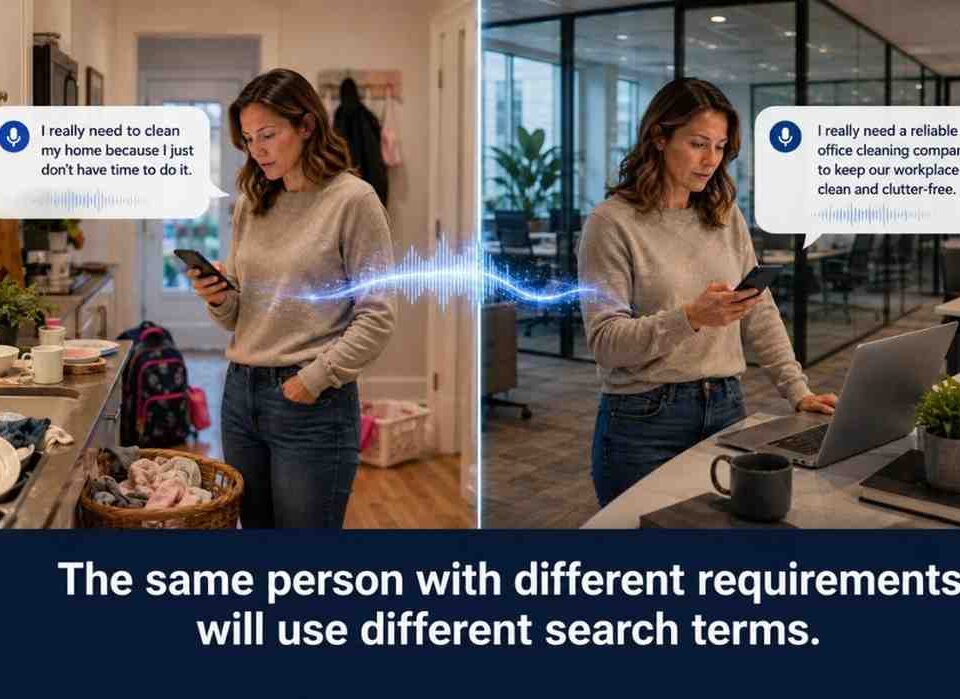
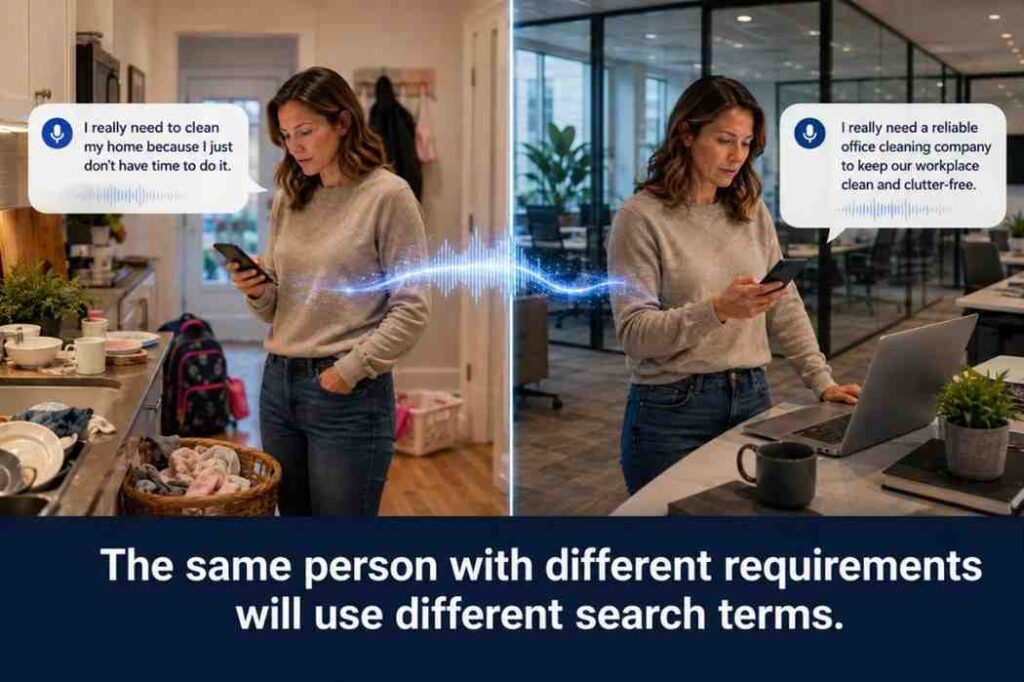
A person looking for a domestic cleaner before Christmas has a very different requirement from an office manager looking for a recurring commercial cleaning contract. Post-build cleaning, hospitality cleaning and medical cleaning create different questions again.
The job for the website is to make those distinctions clear: the property, the reason for the clean, the standard required, the timing and what happens next.
People are not simply searching for “a cleaner”. They are looking for the right cleaner for their particular situation.
Read: Google AI Search for Cleaning Companies: Win Better Leads Without Wasted Clicks
Tradesmen and Home Service Businesses
Tradesmen often have exactly the expertise AI Search needs, but very little of it reaches the website.
It sits in photographs on a phone, quotations, site visits, conversations at the front door and years of knowing what different problems look like.
A homeowner may search because smoke is coming back down a chimney, a storm has lifted roof tiles, floorboards are worn or a shed window is leaking. They are searching the problem before they necessarily know the trade.
The opportunity is to turn that everyday job knowledge into useful content that helps the homeowner understand the problem and helps search systems identify the right tradesman.
Read: Google AI Search for Tradesmen: How Real Home Repair Expertise Wins Better Leads
How 3R Uses the Same System
We also turned the framework back on ourselves.
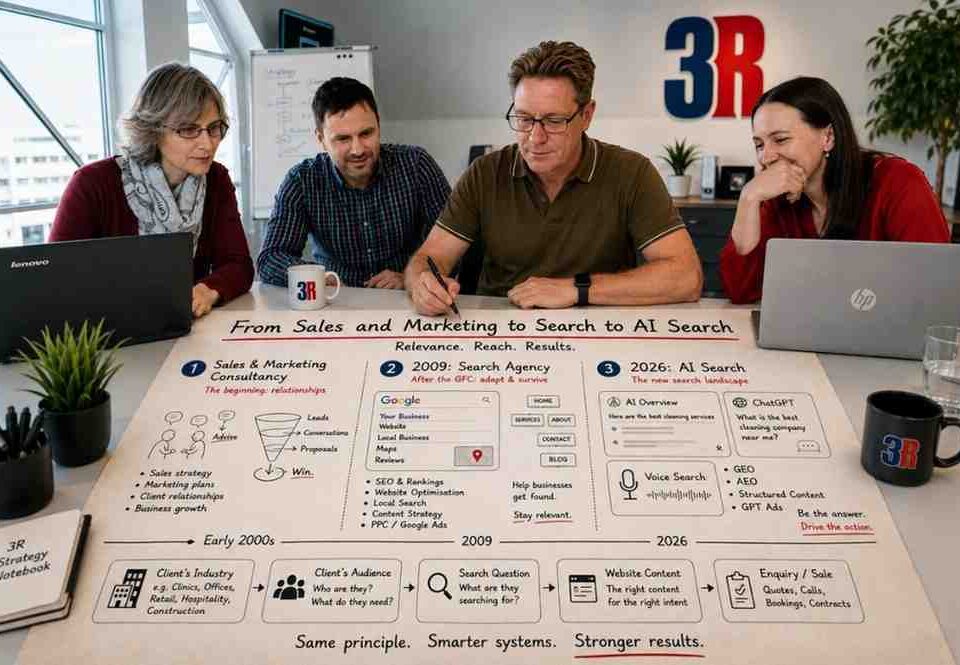
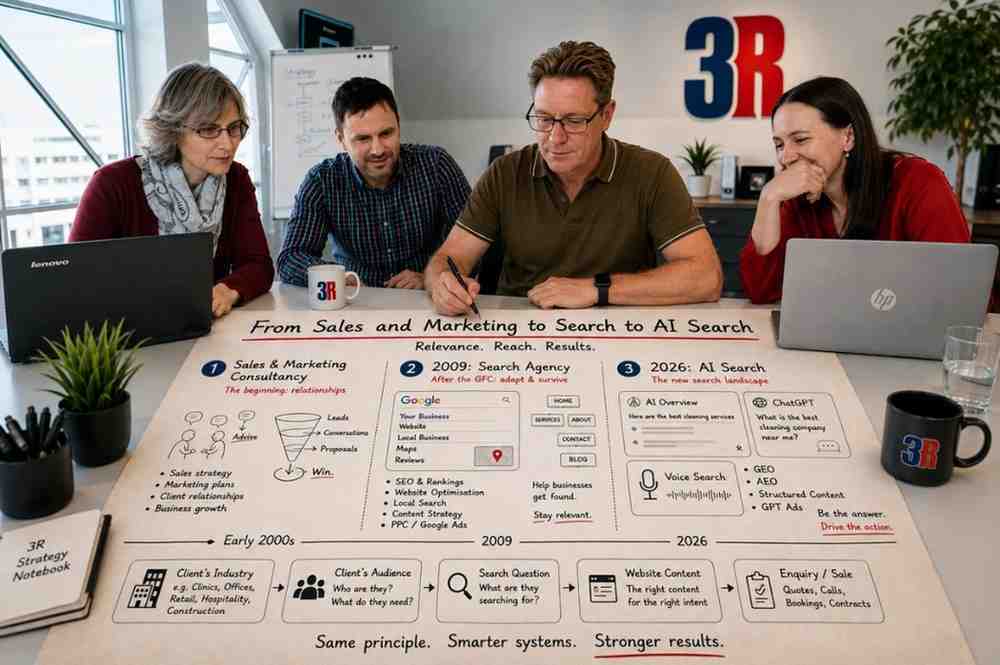
3R has moved from sales and marketing consultancy, through traditional search, and now into AI Search. But the commercial principle underneath it has barely changed.
We create useful content that makes 3R relevant to particular businesses. Search helps those businesses find us. Then the website has to turn that interest into a meaningful conversation.
That is the recursive part of the 3R framework: the way you found us is the way your next client should find you.
Read: Google AI Search Agency: Why 3R Uses Its Own System Before Selling It to You
Professional Services
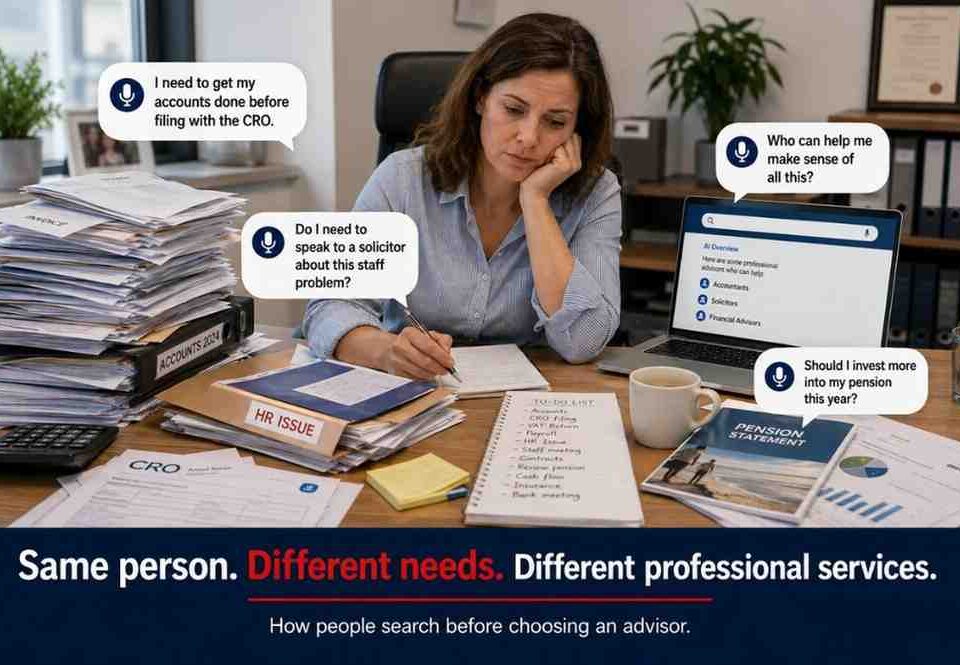
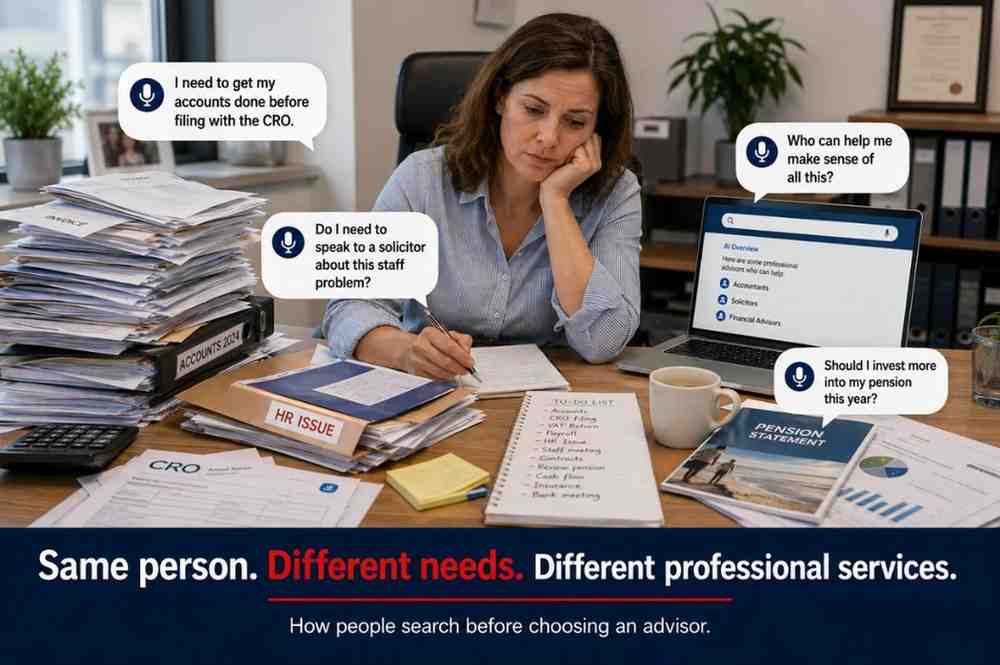
The same principle becomes particularly interesting for accountants, solicitors, financial advisers and other professional service firms.
People often search the problem before they search the professional.
They may know that their CRO filing is approaching, that there is a staff issue they are uncomfortable handling, that they should review their pension or that a property decision needs expert input. What they do not necessarily know is which professional service they need first.
The next article in this series looks at how professional firms can become visible earlier in that decision-making process by answering the real questions around deadlines, risk, money and uncertainty.
Read: Google AI Search for Professional Services
More industries will follow. Over time, the network will connect this central AI Search pillar with industry articles, relevant service pages, client evidence and clear routes to enquiry.
That is how topical authority tends to build in the real world.
Not from one heroic article.
From a body of connected content that proves, again and again, that the business understands the market it is speaking to.
What Should Businesses Do Right Now To Prepare For AI Search?
Businesses should start by clarifying the relationship between their services, their audience and the questions being asked. Then they should turn that into useful website content, stronger search signals and clear next steps.
The first job is to stop thinking only in keywords.
A keyword may tell you what someone typed. It rarely tells you the whole story.
Ask better questions.
What problem does your best client have before they find you? What words do they use before they understand your solution? What doubts slow down the enquiry? What local, emotional, technical or commercial details change the buying decision?
That is where the useful content usually sits.
Next, make the website easier to interpret.
Each important service should have its own page. Locations should not be hidden. FAQs should answer real buying questions, not filler questions invented for SEO. Testimonials and case studies should be used where they help the reader make a decision.
Then build the action gap.
Make sure the website gives the person something AI cannot complete on their behalf. A consultation. A booking. A quote. A product choice. A human review. A next step that feels relevant to their situation.
More often than not, the problem is not technical SEO. It is that the website never explains clearly enough why someone should choose the business.
AI Search is making that harder to hide.
Can 3R Help Your Business Become Relevant in AI Search?
Yes. 3R helps businesses become visible, understandable and commercially useful in the new era of AI Search by combining SEO, AEO, GEO, content strategy, website architecture and conversion-led thinking.
We have been through enough algorithm changes to know that panic rarely helps.
Neither does chasing every new tool.
The businesses that adapt best are usually the ones that go back to the fundamentals and improve them properly. They understand their audience. They communicate clearly. They answer real questions. They build websites that help people take action.
That is what search has always rewarded, even when the technology around it changes.
If your business is worried about losing Google traffic, being ignored by AI Overviews, or becoming invisible inside ChatGPT-style search journeys, it may be time to look at the structure underneath the website rather than just the surface of the content.
Book a Relational Strategy Session or request an AI Search Visibility Audit.
We will show you where your relevance is weak, where your reach is limited and where the commercial journey is leaking.
As this pillar network grows every other week, we will show how the same thinking applies across real industries, starting with counselling and psychotherapy.
Insert Link to this text [Read the counselling and psychotherapy AI Search article here]
Search has changed, but the work underneath it has become more human, not less. The businesses that win now will be the ones that explain themselves clearly, honestly and specifically enough to be understood by both machines and the people behind the searches.