ChatGPT Ads, AI Search and Irish Marketers: A 3R Perspective on Paid AI Visibility, B2C Growth and B2B Limits
July 16, 2026
How Counsellors and Psychotherapists Can Survive and Thrive in the New Era of Google AI Search
July 26, 2026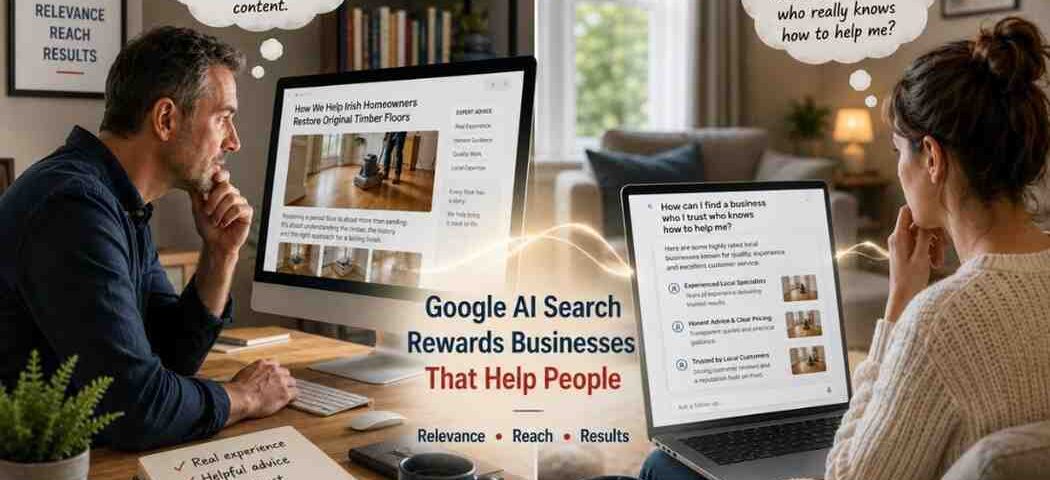
Why Did Google Publish New AI Search Guidelines?
Google’s latest guidance on optimising websites for generative AI has attracted plenty of attention. That is hardly surprising. The search industry has spent the past two years producing new terminology at a fairly impressive rate, with every new acronym presented as the next thing businesses urgently need to understand.
Read Google’s guidance properly, though, and the message is much less dramatic.
Google is not asking businesses to tear up everything they know about search. It is not suggesting that websites need to be rebuilt specifically for AI, or that content must now be written in some strange new format designed for machines.
What it is saying is quite familiar: create useful content, make your website easy to understand and give people a reason to trust your business.
In other words, spend less time trying to outsmart the search engine and more time helping the person who has landed on your website.
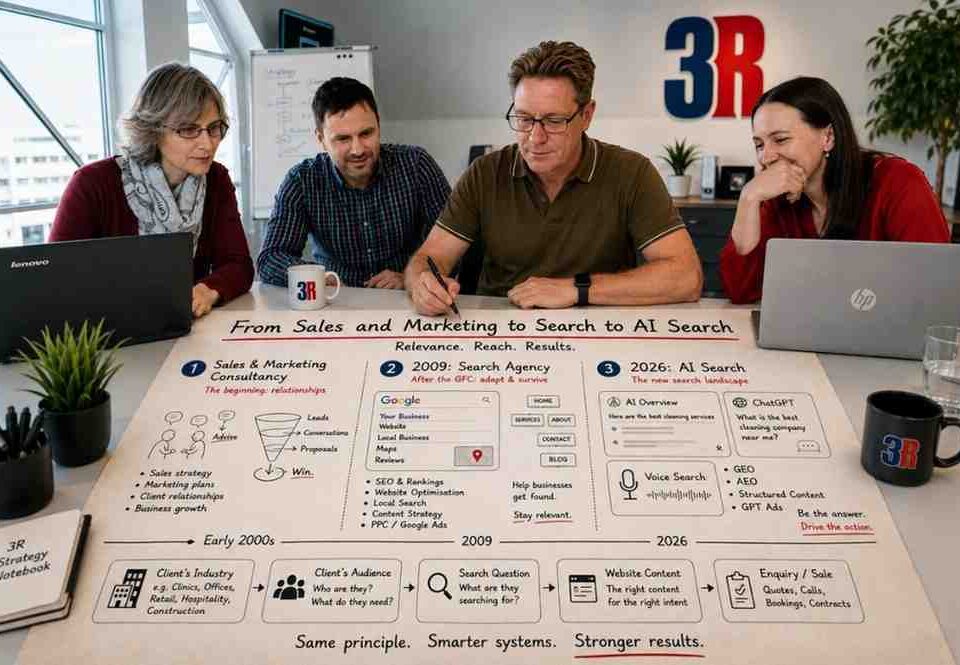
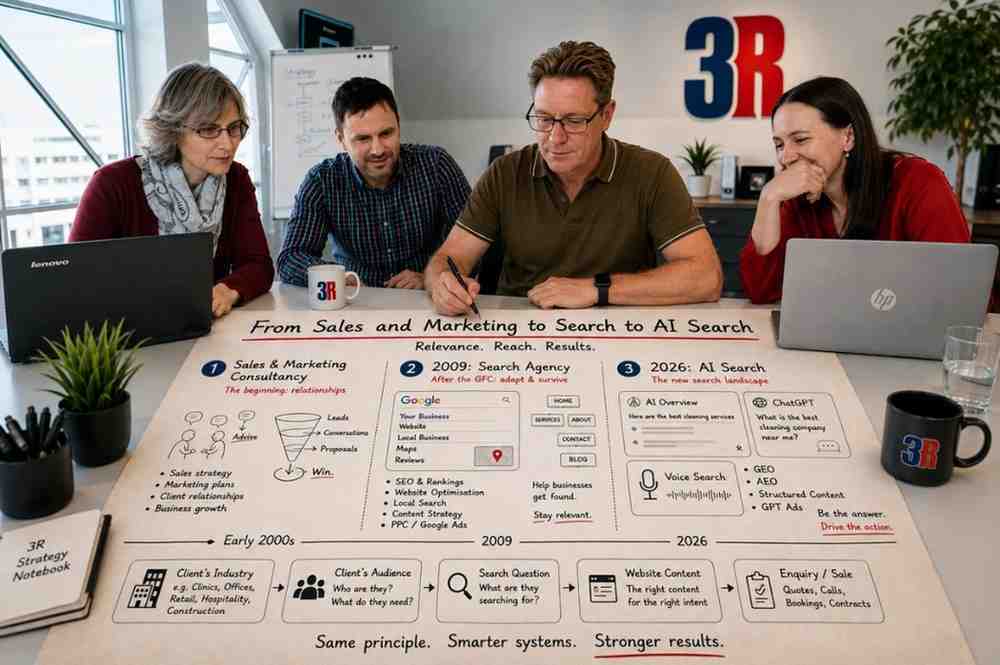
At 3R, we could not help smiling when we read the guidance. Not because Google had revealed anything especially revolutionary, but because it closely reflected the approach we have followed for years. We are seeing up to 40% conversion rates from “AI assistant” traffic source in GA4 for some of our clients – compared to 2% from usual Google organic or paid search.
Everything we do comes back to three principles:
- Relevance
- Reach
- Results
The technology has changed beyond recognition. People have not changed nearly as much.
TL;DR — What Does Google’s New AI Search Guidance Really Mean?
Google has confirmed that there are no special shortcuts to visibility in AI search. Businesses still need original, experience-led content, technically sound websites and clear evidence of expertise.
The fundamentals of good marketing remain much the same. Google has simply become better at recognising whether a website is genuinely useful or has been built to satisfy an SEO checklist.
What Actually Changed?
If you have invested properly in SEO over the years, Google’s latest guidance should be more reassuring than worrying.
Many people assumed AI search would replace traditional search altogether. Others believed they would need to create separate content for AI tools, rebuild large parts of their websites or start publishing in a completely different way.
Google’s documentation suggests otherwise.
AI Overviews and other generative search features are still built on the same foundations as Google Search. Google needs to be able to crawl your pages, understand what they are about and assess whether the information is useful and trustworthy.
If Google struggles to find your content or make sense of your website, AI is not going to solve the problem for you.
The real shift is less technical than many people expected. It is mainly about quality.
There was a time when a technically optimised page with the right backlinks could outperform a more useful piece of content. That has not disappeared entirely, and search is still far from perfect, but it is becoming a less dependable way to compete.
Google is getting better at recognising the difference between a page that genuinely answers a question and one that merely includes the right phrases in the right places.
That is a healthy direction for search to take.
For over twenty years, I have watched businesses chase algorithms. One tactic replaces another, the industry rushes to adopt it and Google eventually adjusts. The cycle then starts again.
The irony is that Google’s latest guidance points businesses back towards the things that should have mattered all along: being useful, demonstrating real knowledge and making it easy for people to find what they need.
Why Is Relevance More Important Than Ever?
Google’s guidance warns against what it describes as “commodity content”. This is generic material that repeats information already available across dozens of other websites without adding much of its own.
There is now an enormous amount of this content online. AI can summarise common information in seconds, so another polished but generic article is unlikely to offer much value.
The more useful question for a business is this: what can we publish that cannot be easily copied or recreated?
Usually, the answer is your own experience.
- An accountant can explain how recent Irish tax changes are affecting real small businesses, rather than simply repeating the wording of the legislation.
- A counselling practice can answer the questions people are often too nervous to ask before making first contact.
- A floor sanding specialist can explain why restoring an old oak floor in a Victorian Dublin house is completely different from sanding a modern engineered floor. They can show the damaged boards, the repairs, the awkward corners and the issues that only became obvious once the work began.
That kind of content does more than provide information. It shows that the business has actually done the work.
We have found that the strongest-performing content usually starts with a real conversation. It may be a question a client asked on the phone, a concern that comes up during consultations or a problem the team sees repeatedly on site.
That is where useful content tends to come from.
AI is very good at summarising what is already known. It cannot replace the knowledge that comes from years of dealing with real customers, real properties and real problems.
That is where genuine relevance comes from.
Why Does Reach Still Depend on Technical SEO?
One of the more persistent misconceptions around AI search is that technical SEO no longer matters.
In reality, Google’s guidance reinforces the opposite.
Google’s AI features still need to find your content, understand the structure of your website and work out how individual pages relate to one another. If the website is slow, confusing or difficult to crawl, those problems do not disappear simply because AI is involved.
The usual fundamentals still matter: clear page structures, descriptive headings, logical internal links, mobile-friendly design, semantic HTML, meaningful alt text and sensible use of structured data.
None of this is especially glamorous, but it is important.
Think of it like opening a showroom. You might have excellent products and knowledgeable staff, but if customers cannot find the entrance or the signs make no sense, the experience begins badly.
Websites behave in much the same way.
- A counselling practice may have thoughtful articles answering exactly the questions potential clients are searching for, but poor internal linking can leave those pages buried and disconnected from the rest of the site.
- A flooring company may have years of impressive project photographs and restoration work hidden several clicks away from the homepage. The expertise exists, but neither customers nor search engines can find it easily.
Sometimes the answer is not another article. It is better navigation, stronger internal linking, clearer page titles or a more sensible website structure.
Small technical improvements often create much larger opportunities than businesses expect.
Why Do Results Matter More Than Rankings?
One question comes up regularly now: “How do we appear in ChatGPT?”
It is an understandable question, but after a little discussion, it usually becomes clear that appearing in ChatGPT is not the real objective.
What the client actually wants is more enquiries, more conversations and more customers.
Being mentioned by an AI platform is only useful if it contributes to those outcomes.
Google’s latest guidance cuts through many of the myths surrounding AI Search SEO. It does not recommend creating pages purely for AI systems. It does not tell businesses to rewrite every article in a machine-friendly style. It certainly does not suggest that adding a fashionable technical file to a website will suddenly transform its performance.
Instead, Google keeps returning to practical improvements.
Keep your Google Business Profile accurate. Make sure product and service information is current. Help search engines understand what your business does. Answer customer questions clearly and make the website easy to use.
These things improve search visibility, but they also make a business easier to trust.
At 3R, we have always believed that rankings only matter when they lead to something useful. A number-one position that attracts the wrong visitors or generates no enquiries is not a commercial success.
High traffic can look impressive in a report. It feels less impressive when the phone remains quiet.
Results have always been the point.
Why Is Human Expertise Becoming Your Greatest Competitive Advantage?
A large share of online content is now AI-generated. That does not automatically make it poor content, and it certainly does not mean AI is the problem.
We use AI ourselves. It is useful for organising ideas, improving structure, checking readability and supporting research.
The important distinction is how it is used.
AI can be an excellent assistant. It is a poor substitute for genuine expertise.
It cannot sit across the table from a client and notice the question they are struggling to ask. It cannot inspect an old property, uncover an unexpected problem or understand why a seemingly simple job has become more complicated once the work begins.
That experience still comes from people.
- It is why a solicitor explaining probate law in plain English often feels different from another generic legal article.
- It is why an experienced physiotherapist can describe not only the injury itself, but also the concerns patients tend to have when they walk into the clinic.
- It is why an electrician discussing the realities of rewiring older Irish homes can mention the awkward access, hidden junctions, damaged plaster and other surprises that rarely appear in a generic guide.
Those details carry credibility because they come from real work.
Google’s E-E-A-T principles — Experience, Expertise, Authoritativeness and Trustworthiness — matter more in an environment where generic information is easy to produce.
Trust is no longer simply part of branding. Increasingly, it also affects whether a business is found.
What Does This Mean for Irish Businesses?
For many Irish businesses, Google’s latest guidance is encouraging.
You do not need hundreds of thin articles. You do not need thousands of backlinks. You do not need to chase every new AI trend that appears on LinkedIn.
You need to become a genuinely useful source of information for your customers.
- A family law solicitor already understands the questions anxious clients ask every day.
- A home care provider knows what families worry about when an elderly parent needs additional support.
- A chimney specialist has seen the blocked flues, damaged liners and damp problems homeowners often miss until the weather turns cold.
That knowledge matters.
When it is turned into clear, well-organised content, it helps customers make decisions and gives search engines a better understanding of the business behind the website.
Large organisations may have bigger marketing budgets and larger content teams. Smaller businesses often have something much harder to reproduce: years of direct, practical experience.
The difficulty is that this knowledge often remains inside the business. It is discussed on phone calls, explained during appointments or shared informally with customers, but never makes its way onto the website.
That is the opportunity.
What Should Businesses Do Next?
Google has not changed what good marketing looks like. It has simply become better at recognising it.
If your website has become quieter in recent years, do not immediately assume you have been penalised. It may be more useful to take a step back and ask a few practical questions.
Are you answering the questions customers genuinely ask? Does the content reflect your own experience? Can search engines easily understand how the website is organised? Would someone reading your pages feel confident enough to contact you? Are you sharing something useful, or repeating information already available elsewhere?
These questions are more valuable than chasing another AI SEO tactic.
Perhaps the biggest lesson from Google’s guidance is that AI search has not replaced human communication. It has made weak communication easier to spot.
Businesses that explain things clearly, show what they know and help people make informed decisions are in a stronger position.
Businesses publishing content simply because they feel they should have a blog will find it more difficult to stand out.
That is not necessarily bad news. It may simply mean getting back to the work that good marketing has always been about: helping people understand their options and decide what to do next.
Frequently Asked Questions About Google AI Search
Does Google recommend creating content specifically for AI?
No. Google recommends creating original, useful content for people. If visitors find your content helpful and Google can understand it, its AI systems are more likely to use or reference it.
Is traditional SEO still important?
Yes. Google’s AI features still rely on the same core search systems. Technical SEO, clear website structure, useful content and strong internal linking remain important.
Is AI-generated content automatically bad?
No. Google looks at the quality and usefulness of the content rather than simply how it was produced.
AI can support writing, research and structure, but human expertise, judgment and editing are still needed if the content is going to say anything worthwhile.
What is the biggest mistake businesses make?
Many businesses publish generic content that adds little to what is already available online.
Google is encouraging businesses to share direct experience, practical knowledge and original insight instead of producing another version of the same article.
Will AI replace websites?
No. AI systems still need reliable sources from which to gather information.
Businesses with useful, authoritative and experience-led websites are more likely to become those sources.
What is the biggest lesson from Google’s latest guidance?
Stop looking for shortcuts.
Build a website that deserves to be recommended, then make it easy for Google and its AI systems to understand why.
Ready to Discover How Visible Your Business Really Is?
Google’s position is fairly clear. The businesses that succeed in AI search will not necessarily be the ones chasing every new trend. They are more likely to be the businesses publishing useful content, maintaining technically sound websites and demonstrating genuine experience.
At 3R, we help businesses improve their Relevance, extend their Reach and deliver measurable Results through strategic SEO, Google AI Search and conversion-focused websites.
Our Strategic Search Audit looks beyond rankings. We assess how well your website performs in Google Search, how prepared it is for AI-powered search, where competitors may be gaining an advantage and which practical improvements are most likely to generate more enquiries and customers.
Because visibility on its own is not enough. People still need a reason to choose your business.
Book your Strategic Search Audit and find out where your website is helping, where it is holding you back and what is worth fixing first.