Why Your Business Is Disappearing from Google and AI Search — And How 3R Builds the Architecture to Bring It Back
July 6, 2026
Google AI Search: Has Google Finally Ended the AI SEO Hype?
July 20, 2026ChatGPT Ads, AI Search and Irish Marketers: A 3R Perspective on Paid AI Visibility, B2C Growth and B2B Limits
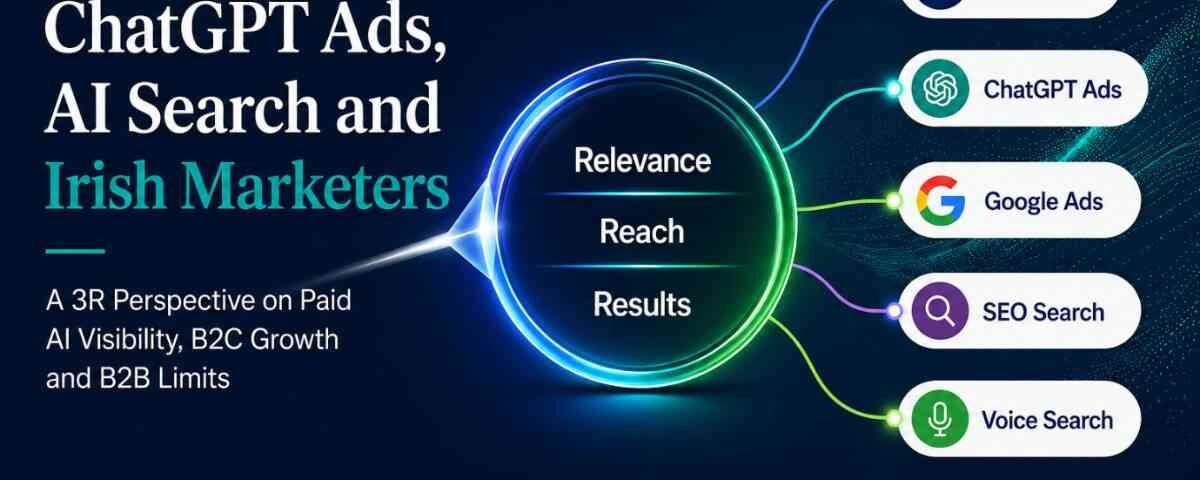
ChatGPT Ads are not simply another paid media format. They are an early sign of how commercial visibility is moving into AI Search, conversational discovery and decision support. For Irish marketers, the issue is not whether this becomes “the next big channel”, but how it changes the way brands earn and buy attention when customers are asking AI systems for guidance.
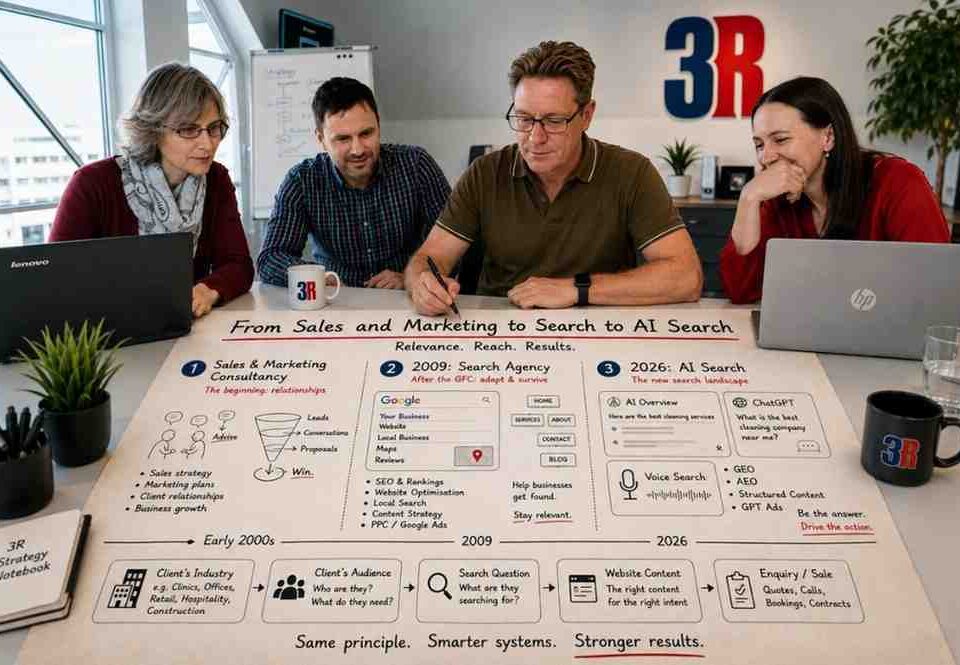
At 3R, we look at this through Relevance, Reach and Results. Relevance means being surfaced when AI understands the user’s problem. Reach means being visible across the emerging environments where discovery now happens. Results means connecting that visibility to measurable business outcomes, rather than treating AI presence as a vanity exercise.
OpenAI’s advertising rollout brings that thinking into sharper focus. ChatGPT Ads are now appearing in selected markets for eligible users, with Ireland not yet officially live. The UK rollout matters because it brings the channel close to Irish commercial conditions, Irish agency planning and Irish consumer behaviour. The brands using this window well are not waiting for a launch announcement; they are reviewing AI Search visibility, content structure, landing pages, measurement and customer-question data now.
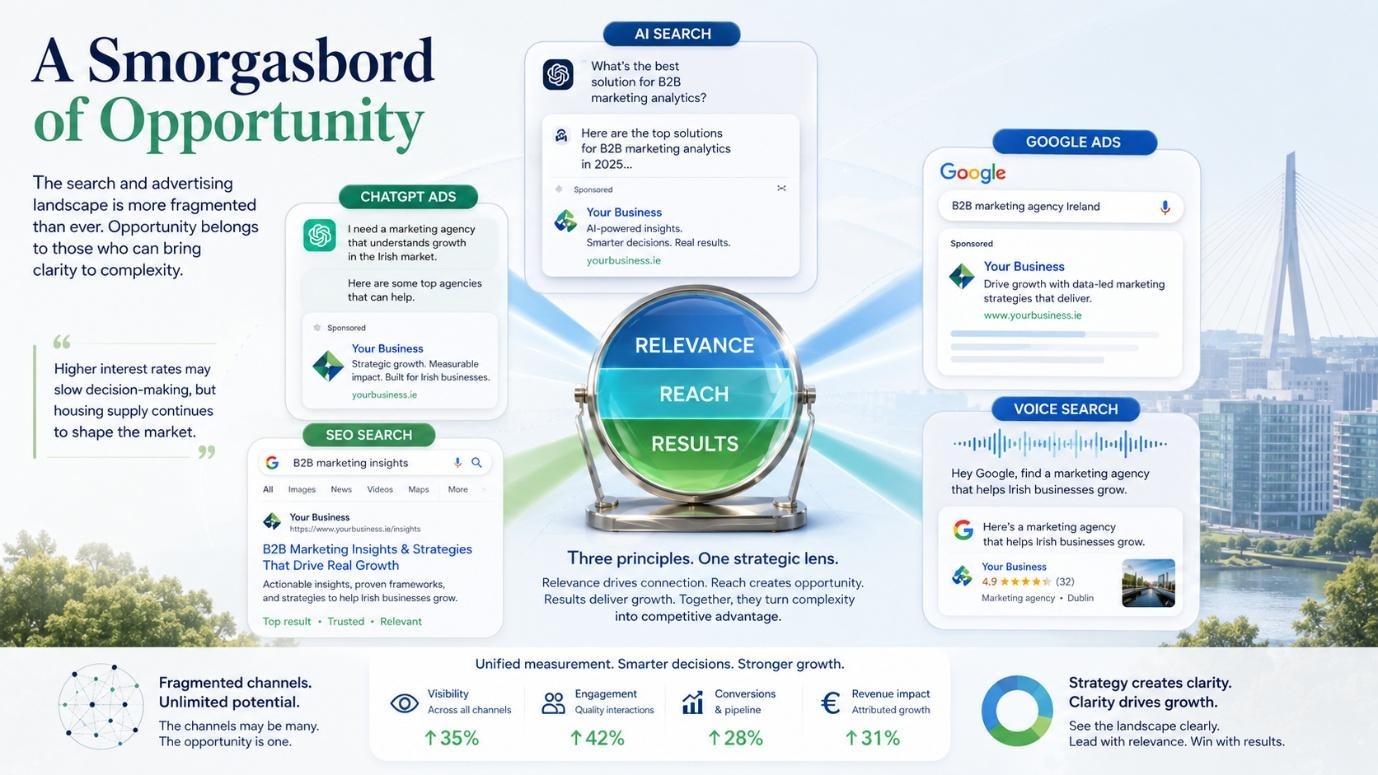
The search and advertising landscape is fragmenting across AI Search, ChatGPT Ads, Google Ads, SEO Search and Voice Search. Brands that connect relevance, reach and results will be best placed to turn complexity into growth.
This is not a panic moment. It is a preparation moment.
ChatGPT Ads Inside the AI Discovery Journey
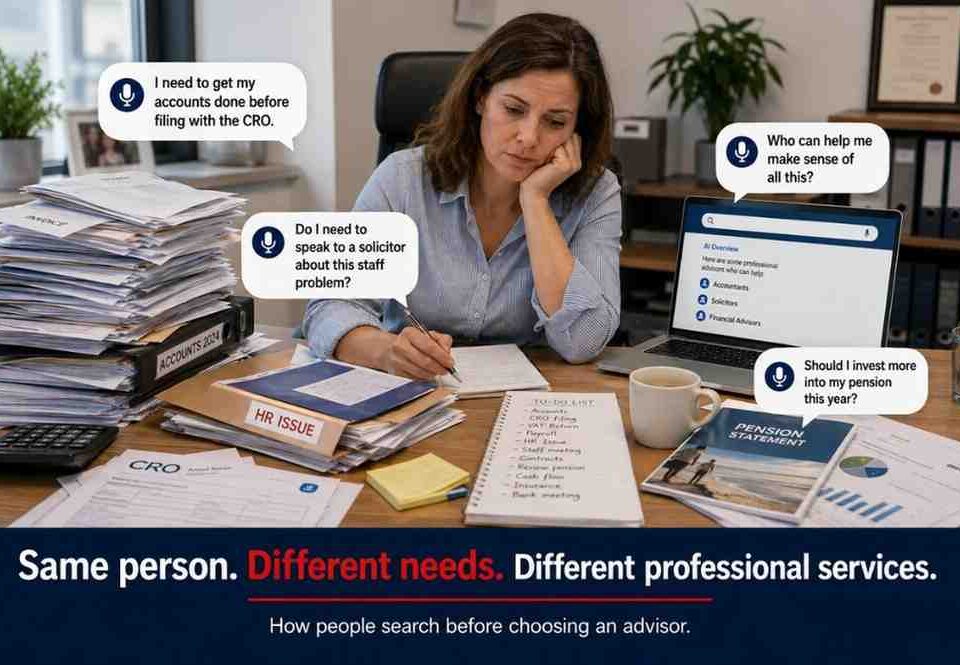
ChatGPT Ads sit inside a behaviour that is different from search and social. The user is not choosing between blue links or being interrupted by a feed placement. They are asking for help, refining a problem, comparing options and often revealing commercial intent in a more natural way than they would through a keyword.
The sponsored format appears as a clearly labelled placement below the organic ChatGPT response. It can include advertiser identity, a headline, description, image and destination link. OpenAI states that ads are separate from the organic answer, that buying media does not allow advertisers to manipulate ChatGPT’s response, and that ads are currently shown only to eligible Free and ChatGPT Go users while Plus, Pro, Business, Enterprise and Edu users remain ad-free. (OpenAI Help Centre)
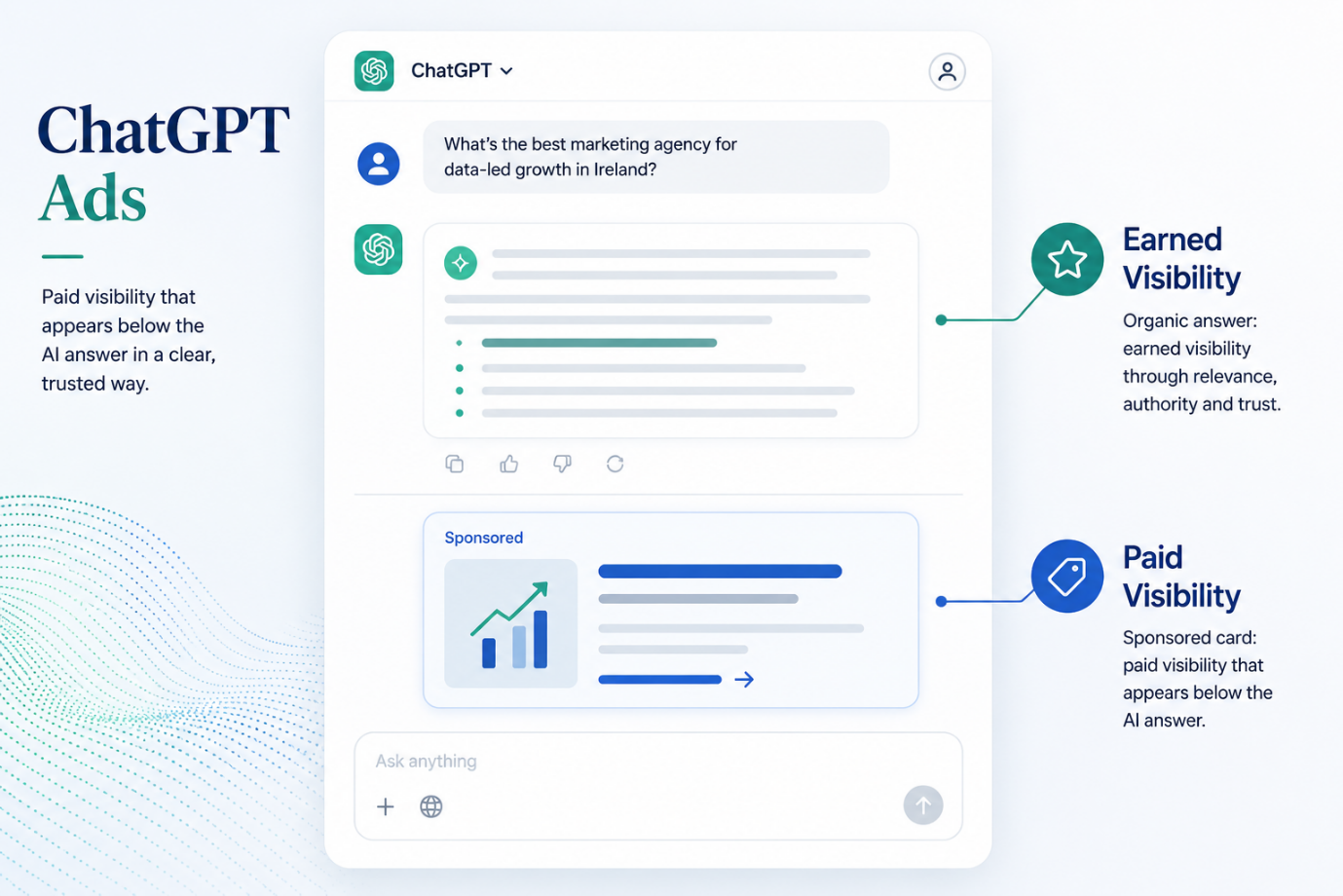
That separation is critical. Paid placement can create visibility around a conversation, but it does not buy inclusion in the answer itself. For marketers used to managing paid search, SEO, social and conversion separately, this creates a more integrated planning problem. The ad, the landing page, the organic AI footprint and the brand’s wider authority signals all need to work together.
The targeting model also requires a shift in thinking. ChatGPT Ads are not built around exact-match keywords in the Google sense, and they are not simply behavioural audiences in the Meta sense. They rely on contextual signals from the conversation, the ad, the landing page and the user’s immediate task. That rewards advertisers who understand customer problems in detail, not those who only translate existing search campaigns into shorter ad copy.
The Real Difference Between Paid and Earned AI Visibility
AI Search is earned visibility. ChatGPT Ads are paid visibility. Strong brands will increasingly need both, but they should not confuse the two.
AI Search is the work of being understood, trusted and surfaced by AI systems when users ask for help. That includes content quality, topical authority, structured information, brand mentions, reviews, third-party references and the clarity with which a business answers real customer questions. For teams still defining the discipline internally, our guide to What is AI Search? sets out the foundations.
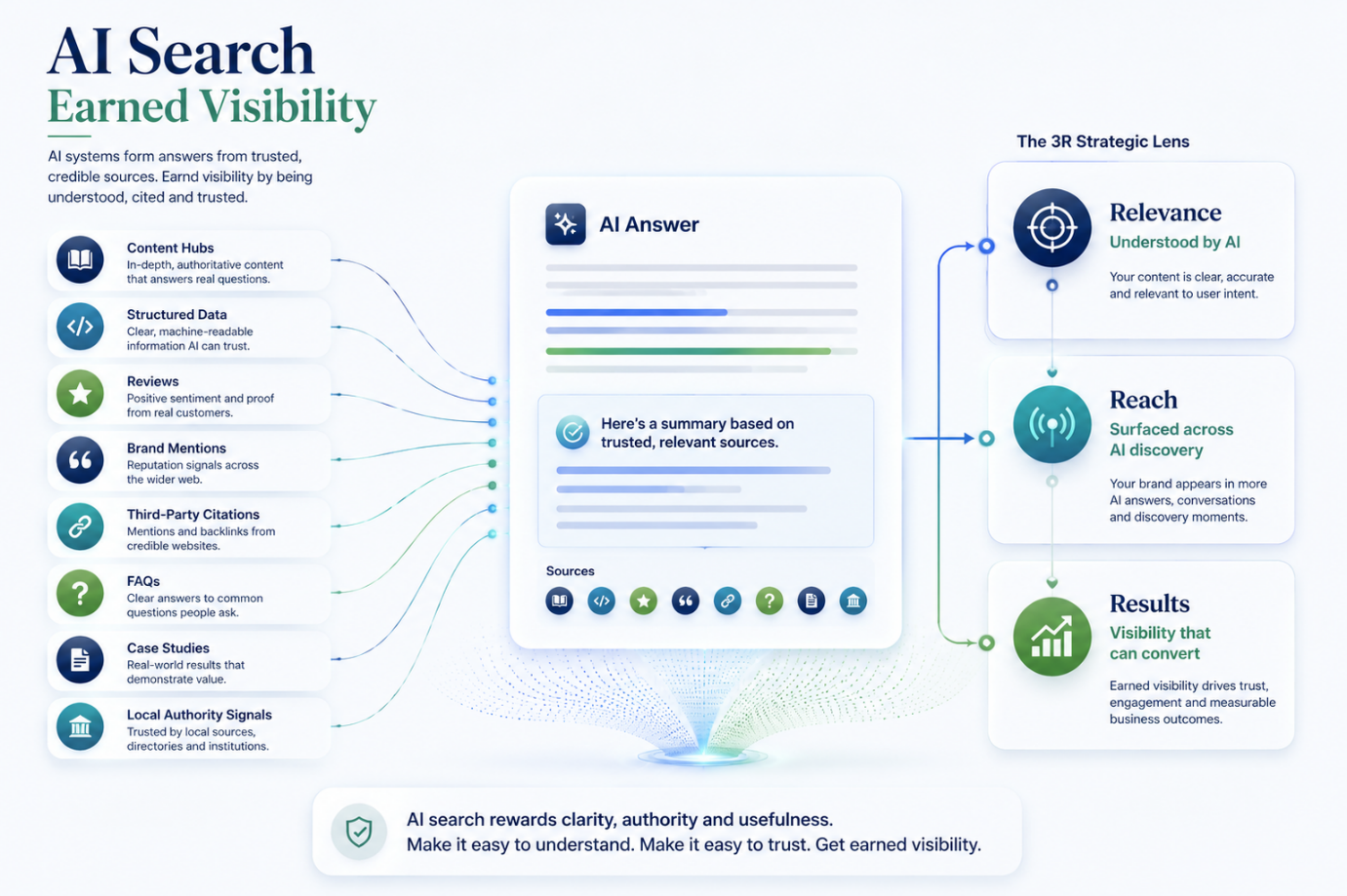
ChatGPT Ads, by contrast, are paid placements around relevant AI conversations. They may help a brand reach users quickly, but they do not replace the longer-term work of earning visibility in AI-generated answers. A business that ignores AI Search may end up overpaying for traffic it could have partly earned through stronger content, better authority signals and clearer positioning.
This is the same pattern we have seen in earlier channel shifts. Brands that neglected SEO became more dependent on paid search as auctions matured. Brands that failed to build organic trust on social platforms had to buy more attention later. AI discovery is likely to follow a similar path. Businesses with stronger earned AI visibility should have an efficiency advantage because users encounter them more consistently, landing pages match intent more closely, and paid clicks arrive with more context.
That is why AI Search Optimisation now belongs in the same strategic conversation as media planning. It is not an SEO rebrand. It is the practical work of making a business legible to AI systems before paid AI advertising becomes more competitive.
The B2C Opportunity and the B2B Catch
The audience split is one of the most commercially important details in the ChatGPT Ads rollout. Ads are shown to Free and ChatGPT Go users, while paid professional and organisational plans are shielded. That immediately makes the channel more attractive for many B2C advertisers than for traditional B2B demand generation.
For Irish consumer brands, the logic is strong. Free and lower-cost users are likely to ask ChatGPT for help with holidays, healthcare, fitness, insurance, education, ecommerce, personal finance, local services and home improvement. These are categories where people want reassurance, comparisons and practical guidance before they act. A sponsored placement can work well if it helps the user move from uncertainty to action.
For B2B, the picture is more selective. Senior decision-makers, agency leaders, consultants, developers, finance teams and enterprise users are more likely to be on paid ChatGPT plans. If they are using Plus, Pro, Business, Enterprise or Edu, they will not see the ads. That does not remove B2B opportunity entirely, but it narrows the audience to sole traders, founders, microbusinesses, SMEs and users who remain on Free or Go.
This distinction matters for Irish marketers. A local accountant, training provider, HR consultant, web agency, insurer or SaaS product aimed at small operators may find useful demand. A high-value enterprise software provider should be more cautious. ChatGPT Ads should not be treated as LinkedIn with stronger intent; the reachable audience may be materially different.
Pricing, Bidding and Performance Expectations
Current US and UK market references suggest CPMs around $25–$45, recommended CPC floors of $3–$5, and CPA bidding entering the performance mix as of June 2026. OpenAI’s advertiser materials also describe CPM and CPC buying, Ads Manager access, pixel-based measurement and Conversions API support.
Those numbers suggest a channel positioned around quality of context rather than cheap reach. If a user has spent several turns clarifying a need, comparing options and setting constraints, the click may be more valuable than a standard display or social click. But that value will only show up where the advertiser has strong alignment between the conversation, the offer and the post-click experience.
Early benchmarks should be treated carefully. New platforms often produce uneven results because creative norms, auction pressure, measurement and user behaviour are still forming. A €4 equivalent click may look expensive against mature search campaigns, but it may be reasonable for healthcare, insurance, education, financial services, home improvement or other high-value consumer decisions. The weaker tests will be those that treat the channel as a novelty placement rather than a specific commercial context.
Measurement needs attention before budgets move. ChatGPT-driven journeys may not convert in a clean, last-click pattern. A user might see a sponsored card, revisit the brand through Google, compare alternatives through another AI tool and convert later through direct or email. That means Irish advertisers should prepare clean conversion events, CRM source quality, consent-aware analytics and assisted-conversion reporting before expecting reliable answers from the data.
What We’re Seeing in Client Conversations
Many Irish businesses are focusing on AI tools while ignoring AI visibility. They are asking how to use AI to write content faster, automate internal workflows or generate campaign ideas, but fewer are asking whether AI systems can understand, trust and surface their brand when customers are actively researching. That gap will become more expensive as paid AI channels mature.
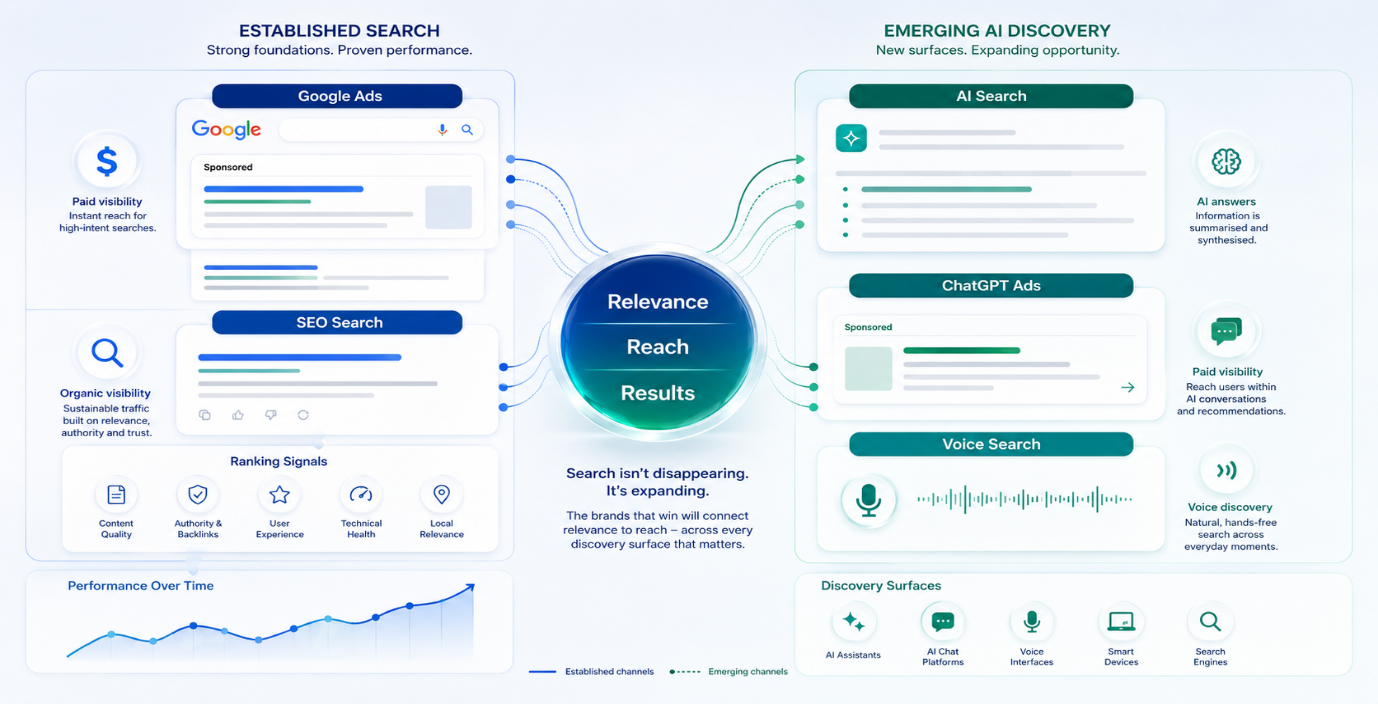
We are also seeing confusion between AI Search, Google Ads and SEO Search. Some teams assume Google Ads will solve visibility problems that actually belong to content, authority and structured information. Others treat AI Search as SEO with a new label, when the work is broader: entity clarity, answer quality, source credibility, customer-language mapping and visibility across multiple generative environments.
The measurement conversation is still immature in many businesses. Marketing teams know AI-influenced journeys are happening, but their analytics often cannot show where AI contributed. Referral data is incomplete, users move between tools, and many conversions still get credited to direct, organic search or branded search. That does not mean the influence is absent. It means the measurement infrastructure has not caught up with the behaviour.
The more prepared teams are starting with questions rather than channels. They are identifying where customers seek reassurance, where comparison happens, where trust breaks down and where existing content fails to answer the real decision. That work improves AI Search now and creates a stronger base for ChatGPT Ads later.
Why the UK Rollout Matters for Ireland
ChatGPT Ads are live in selected markets including the US, Canada, Australia, New Zealand, Japan, South Korea and the UK. They are not officially live in Ireland yet. The UK rollout matters because it gives Irish agencies and growth teams an early view of pricing, creative patterns, user response and sector-level adoption in a market close to our own.
Ireland’s timing will likely be shaped by EU consent and personalised advertising regulation. That may slow local availability, but it gives Irish businesses a useful planning window. The work worth doing now is not speculative budget shifting; it is readiness. Which sectors have obvious conversational demand? Which clients have landing pages too generic for AI-led traffic? Which brands already appear in AI Search, and which are invisible?
The UK will become a useful learning environment, especially for Irish businesses already active there. But Irish teams should avoid copying UK playbooks without adjustment. Local proof, regulation, trust signals, buying behaviour and service expectations still matter. AI discovery may be global in technology, but conversion remains local in practice.
The Work Worth Doing Before Ireland Goes Live
The most useful preparation is an AI visibility and conversion readiness review. ChatGPT Ads may create paid reach, but performance will depend heavily on whether the brand is already credible, understandable and useful in AI-mediated journeys.
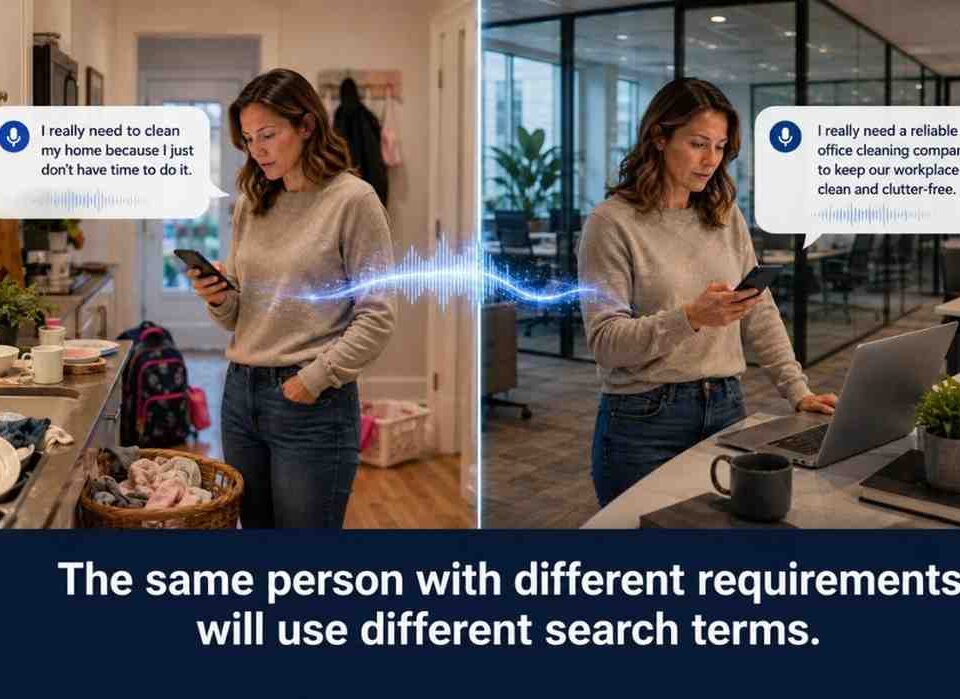
Start with commercial conversation mapping. Sales calls, customer service emails, live chat, internal site search, reviews, Reddit threads, Google Search Console data and paid search terms all show how people frame problems before they buy. For a mortgage broker, that may involve self-employed income, approval timelines and deposit anxiety. For a clinic, it may involve symptoms, treatment concerns, pricing and trust. For a hotel, it may involve weather, children, parking and local activities.
Then review AI Search visibility. Where does the brand appear today? Where do competitors appear? Which sources are AI systems relying on? Are the business’s services, locations, expertise and proof points easy for AI systems to understand? These questions sit at the centre of Relevance because AI cannot surface what it cannot confidently interpret.
Landing pages should also be reviewed against decision moments, not just services. Too many Irish businesses still send paid traffic to broad pages that try to cover every audience at once. AI-led traffic is likely to be more specific. A person asking about dental anxiety, solar payback periods, mortgage approval as a sole trader or wet-weather family breaks deserves a page that continues the same conversation.
Finally, measurement should be made fit for assisted journeys. That means agreed conversion definitions, consent-aware tracking, CRM fields that identify lead quality, offline conversion capture where relevant, and reporting that does not rely entirely on last click. Without that, ChatGPT Ads may appear either less valuable or more valuable than they really are.
A 3R View of Paid AI Visibility
For 3R, ChatGPT Ads sit at the intersection of AI Search, paid media, content strategy and conversion performance. They are not a standalone media product to be handed only to a PPC team, and they are not a replacement for earned visibility. They are part of a wider AI discovery system.
Relevance is the starting point. A brand needs to be surfaced when AI understands the user’s problem, whether that happens organically through AI Search or through a paid placement. Reach comes next: visibility across the expanding set of places where people research and compare. Results are the commercial discipline that prevents AI visibility from becoming another vague awareness metric.
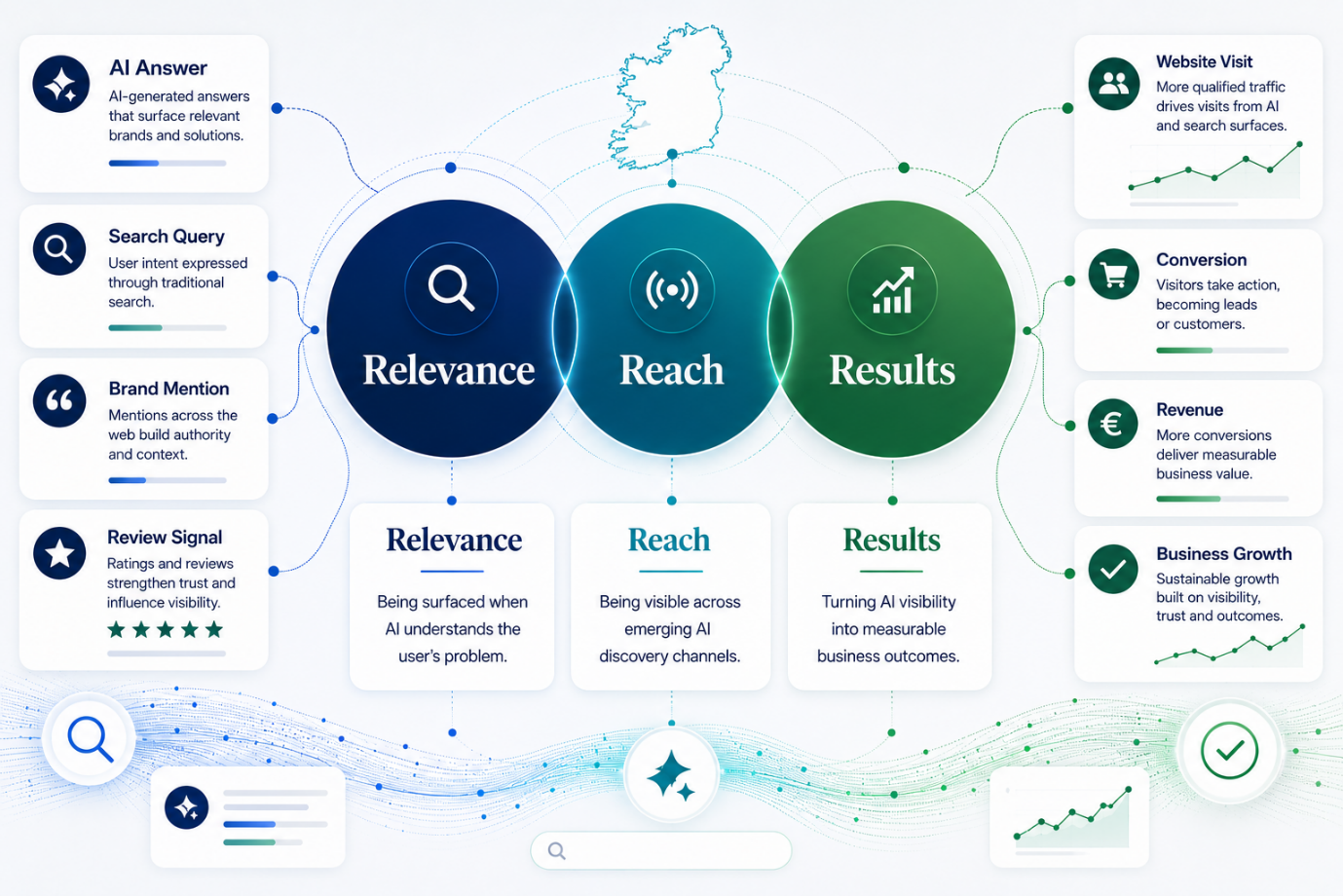
That combination is where many campaigns will either succeed or waste money. A business with weak content, unclear positioning, generic landing pages and poor tracking will struggle even if it buys the placement. A business with strong AI Search foundations, clear customer-language mapping and a measurement setup built for assisted journeys will be in a much better position when the channel opens.
Strategic Takeaway for Irish Marketers
ChatGPT Ads will not replace Google Ads, Meta Ads, LinkedIn Ads or SEO. They add another layer to a discovery environment that is already becoming more fragmented and more AI-mediated. The near-term opportunity is strongest for B2C brands where consumers use AI to make considered choices, while B2B marketers should be more selective because many professional users sit inside ad-free plans.
The more important point is what ChatGPT Ads reveal about the direction of the market. Paid visibility is moving closer to the moment of advice, comparison and decision-making. Earned AI visibility is becoming a commercial asset, not a content experiment. Measurement will need to account for influence that does not always appear neatly in platform reports.
The real question is not whether ChatGPT Ads arrive in Ireland. It is whether Irish businesses have made themselves visible, understandable and measurable in AI Search before paid AI visibility becomes another crowded auction.