Google AI Search: Has Google Finally Ended the AI SEO Hype?
July 20, 2026
Google AI Search for Driveway and Construction Contractors: How to Turn Real Project Expertise into Better Local Leads
August 1, 2026How Counsellors and Psychotherapists Can Survive and Thrive in the New Era of Google AI Search
What Is Changing for Counsellors and Psychotherapists in AI Search?
Traditional Google search is no longer the only place people look for counselling. Google AI Search, AI Overviews, ChatGPT search and voice search are now helping people ask more personal, emotional and specific questions before they ever visit a therapist’s website.
For counsellors and psychotherapists, this matters more than it does for many industries.
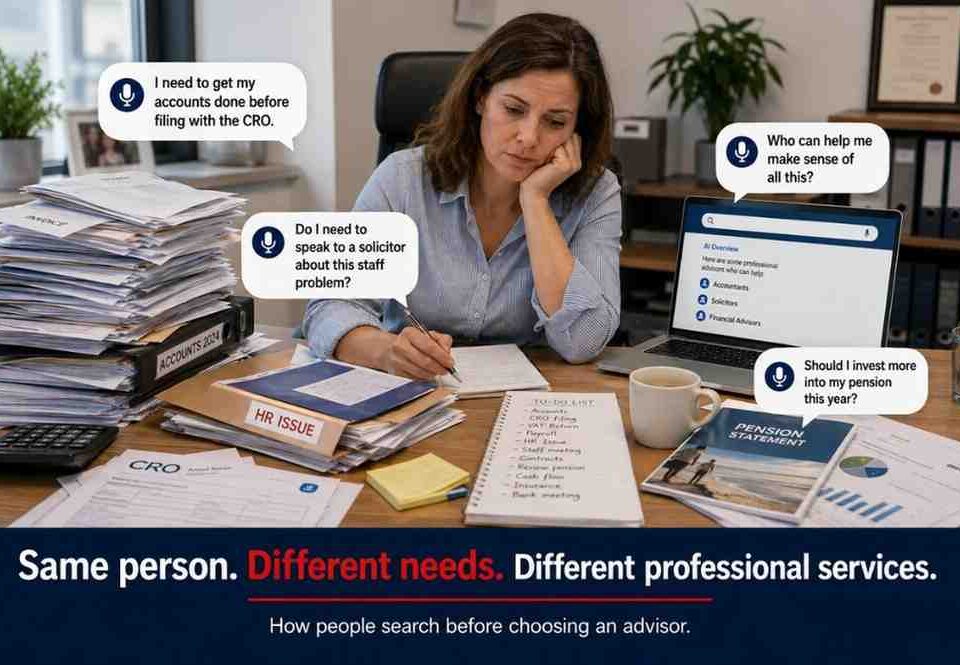
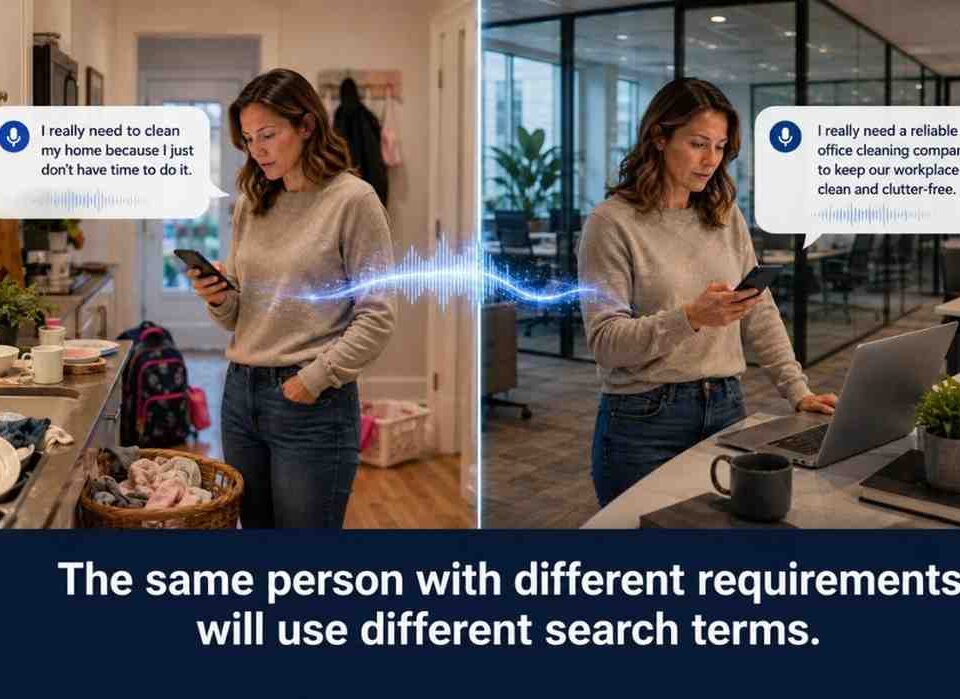
A person looking for help with anxiety, grief, trauma, depression or relationship difficulties is rarely typing like a marketer imagines they are typing. They may not search for “psychotherapist Dublin” or “counselling services Ireland” at first.
They are more likely to ask something human:
“How can I get help for my anxiety?”
“Why do I feel overwhelmed all the time?”
“Where can I find a therapist who understands trauma?”
“What type of therapy is right for me?”
Those questions are now being answered, at least partly, by AI systems.
Google says AI Overviews and AI Mode can surface supporting links to relevant websites where people can explore further, while ChatGPT search provides timely answers with links to web sources. For therapists, the commercial issue is fairly clear: if AI answers the first question, your website has to earn the next click. (Google for Developers – SEO search in AI Era)
Many counselling websites are not ready for that.
They describe the service, but they do not always show the relationship between the client’s emotional state, the therapist’s approach and the next safe step. AI Search did not remove the need for human communication. It exposed where the communication was too thin.
Why Are Counselling Searches Different from Ordinary Service Searches?
Counselling searches are private, emotional and often uncertain. The person searching may not know what kind of help they need, so the website must answer gently and specifically before asking them to book.
This is why generic SEO often falls short for counselling and psychotherapy.
A driveway customer may know they need a driveway. A business buyer may know they need a supplier. Someone looking for counselling may only know that something feels wrong.
They may not know whether they need CBT, integrative therapy, trauma-informed counselling, couples counselling, online therapy or simply a safe first conversation. That uncertainty changes the search journey.
A good counselling SEO strategy has to meet people earlier, before they are ready to enquire. It also has to support them later, when they are comparing therapists and deciding whether they feel safe enough to make contact.
From our experience, the best counselling websites do not push too hard. They create recognition. The reader thinks, “Yes, that sounds like me.” Then, only after that, they take action.
How Does the 3R Framework Apply to Counselling and Psychotherapy?
The 3R framework helps counselling practices become relevant to the person seeking help, reach them across search and AI systems, and turn that moment of trust into a real enquiry, appointment or consultation.
The framework came from experience, not theory.
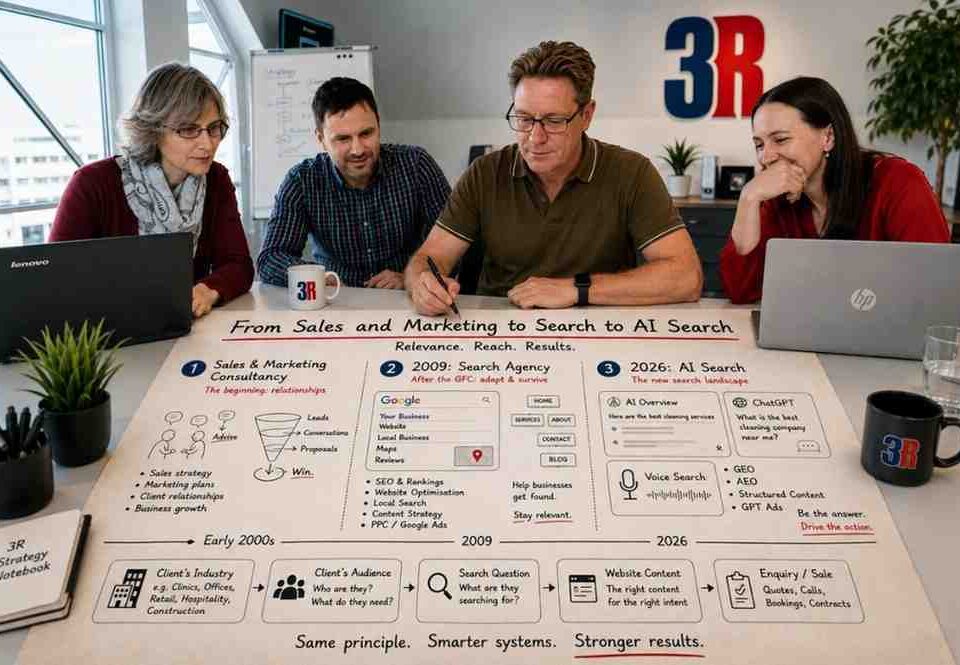
Over time, we noticed the same pattern in strong client work. A business had to be relevant to the audience. It had to reach that audience through search. Then the website had to turn attention into action.
For counselling and psychotherapy, that pattern is especially clear. You are not selling a simple service. You are asking someone to trust you with something personal.
That means the content, search structure and website journey need to be handled with more care than a standard lead-generation page.
How Does Relevance Help Therapists Attract the Right Clients?
Relevance for counsellors means matching your service pages and content to the real reasons people seek help. It is not enough to rank for “counsellor near me”; your website must reflect anxiety, trauma, grief, relationships, location and therapeutic fit.
A counselling website should not feel like a directory listing with a contact form attached. It should help the visitor understand whether they are in the right place.
This is where many therapists are underselling themselves. They may have years of experience, strong qualifications and a thoughtful therapeutic approach, but the website says very little beyond “safe, confidential space”.
That phrase matters, but it is not enough on its own.
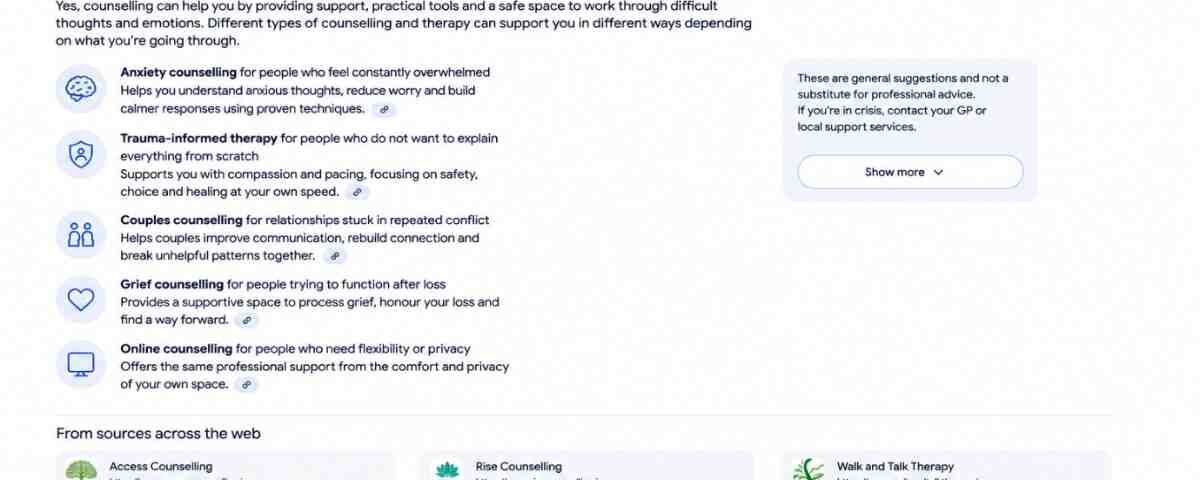
The website needs to connect specific client situations to specific services:
- anxiety counselling for people who feel constantly overwhelmed
- trauma-informed therapy for people who do not want to explain everything from scratch
- couples counselling for relationships stuck in repeated conflict
- grief counselling for people trying to function after loss
- online counselling for people who need flexibility or privacy
One of the strongest proof points in 3R’s counselling work comes from Conn Fitzgibbon, who said 3R built his psychotherapy website and, most importantly, clients were able to find him easily. That is not just a nicer website. It is a clearer route between the person searching and the professional who can help.
The keyword is only the surface. The deeper work is the relationship between the searcher’s problem and the therapist’s ability to respond.
How Does Reach Help Counsellors Appear Across Google AI Search, Voice and Local Search?
Reach for counsellors means making your expertise discoverable across Google Search, Google AI Search, ChatGPT search, voice search, Google Business Profile, local SEO, service pages and helpful counselling articles.
Counselling SEO used to be simpler. You could build a website, add a few service pages, write occasional blog posts and aim for local rankings.
That still helps, but the search environment is now broader. People may ask Google. They may ask ChatGPT. They may use voice search on their phone. They may look for “therapist near me” on Google Maps, then compare the website before making contact.
A strong counselling search strategy now needs several layers working together. The website must have clear service pages. The local signals must be accurate. The FAQs must answer genuine concerns. The content should explain therapy topics in plain language.
Google’s own guidance says pages need to be indexed and eligible for snippets to appear as supporting links in AI Overviews or AI Mode. So the old foundations still matter: crawlability, useful content, page clarity and technical SEO have not gone away. (Google for Developers – AI features and your website)
What has changed is the level of precision required.
A page called “Services” is usually too vague. A page called “Anxiety Counselling in Dublin” or “Online Trauma Counselling in Ireland” gives both the person and the search system a much clearer signal.
This is also where 3R’s long experience in counselling SEO matters. 3R notes that it has worked with several counselling clients in Ireland, including practices focused on mindfulness, CBT, workshops and other therapeutic areas. (3R Counselling SEO Articles)
Counselling is not one category. It is a network of needs, methods, locations and levels of readiness. Reach is not about shouting louder. It is about being present where a person quietly asks for help.
How Do Results Come from Action Gaps on Therapy Websites?
Results come when a counselling website gives the visitor a clear, safe next step that AI cannot complete for them. AI can explain anxiety, trauma or counselling options, but it cannot choose the therapist, book the session or create human trust.
This is the action gap.
AI may answer the first question:
“You can get help for anxiety by speaking to your GP, contacting a counsellor or therapist, or using support services.”
That answer may be useful. It may even calm the person down. But it does not complete the journey. The person still has to decide who to contact.
A good therapy website should make the next step feel manageable. Not aggressive. Not salesy. Just clear.
The visitor should be able to see what you help with, who you work with, where sessions happen, whether online therapy is available, what happens in the first session and how to make contact confidentially.
The Access Counselling testimonial is a strong example of the commercial side of this. After a website redesign and SEO by 3R, Beth Fitzpatrick reported “over 20 new clients most weeks”. For a counselling practice, that is not vanity traffic. That is the website and search journey turning into real enquiries. (3R Consulting SEO Testimonials)
Walk and Talk Therapy gives another practical proof point. After the new website went live, Phil Gormley reported two emails and two calls in 12 hours, all of which booked appointments. (WordPress Web Design Testimonials)
The searcher had a need. The website made the next step easy enough to take.
What Should Counsellors Do First to Prepare for AI Search?
Counsellors should start by building service pages around real client problems, adding AI-readable FAQs and making the enquiry journey simple. The goal is to help search systems understand your expertise while helping people feel safe enough to contact you.
Here are the three steps we would prioritise now.
How Should Counsellors Map Client Intent Before Writing Content?
Start by mapping the real emotional and practical reasons people seek therapy. Do not begin with keywords alone. Begin with anxiety, grief, trauma, relationships, burnout, family pressure, loneliness, location and readiness to talk.
Most counselling content starts too late in the journey. It assumes the person already knows they want therapy.
Many do not.
They may be searching for symptoms, situations or questions before they search for a counsellor. Useful content might answer:
- “Can counselling help with panic attacks?”
- “How do I know if I need therapy?”
- “What happens in a first counselling session?”
- “Can I speak to a counsellor online?”
Each of those questions can become a page, FAQ or article.
The aim is not to turn the therapist into a content machine. It is to make sure the website speaks to the actual search journey, not just the final buying phrase.
How Should Therapists Structure Website Pages for AI and Local SEO?
Each main therapy service should have its own page with clear headings, plain English explanations, location signals, FAQs, therapist credentials, testimonials where appropriate and a simple enquiry route.
A good counselling website should not hide everything under one “Counselling Services” page. That makes life harder for Google, AI systems and the person searching.
A better structure might include:
- Anxiety Counselling
- Trauma Counselling
- Couples Counselling
- Grief Counselling
- Online Counselling
- Counselling in Dublin
- About the Therapist
- What to Expect
- Fees and Appointments
For AI Search, the content should answer questions directly. For local SEO, the pages should show where the therapist works. For human trust, the writing should feel calm and specific.
Schema can also help search systems understand the page. Counsellors should consider appropriate structured data such as LocalBusiness, ProfessionalService, Person, FAQPage and Article schema, used honestly and only where it matches the visible content.
The point is not to decorate the site with technical extras. It is to remove ambiguity.
How Can Counselling Websites Create a Safe Action Gap?
A safe action gap gives the visitor a reason to contact you without feeling pressured. Use clear booking routes, gentle calls to action, first-session guidance, privacy reassurance and direct contact options.
For counselling, the call to action needs care.
“Book now” may work for some practices, but it can feel abrupt depending on the service and audience.
Often, a softer route works better:
- “Arrange an initial consultation”
- “Ask about availability”
- “Send a confidential enquiry”
- “Book a first conversation”
The best therapy websites reduce the emotional effort of making contact. They explain what happens after the form is submitted, how soon someone may hear back and whether the enquiry is confidential.
AI can explain therapy in general. Your website needs to make the next step feel human.
Why Should Counsellors Avoid Generic SEO Agencies?
Counsellors should avoid generic SEO because therapy searches involve trust, vulnerability, ethics and emotional intent. A standard keyword approach may increase traffic but still fail to attract the right clients or support careful decision-making.
This is where a lot of SEO becomes too blunt.
Counselling is not a normal transaction. The website has to be findable, accurate and reassuring. It also has to avoid making promises it should not make.
A generic agency may focus on volume. More traffic is not always better for a therapist. The better question is whether the right person found the right page and felt confident enough to take the right next step.
3R’s own work in counselling and psychotherapy shows the difference between traffic and fit. Rise Counselling is cited by 3R as saying they began to see results very quickly, while Access Counselling and Walk and Talk Therapy both show how website and SEO work translated into real contact and bookings. (3R – The Game Changer in SEO, Google AdWords Management, and WordPress Web Design)
This is not about making therapy sound like a product. It is about making the route to help easier to find.
Where Should Counselling SEO Connect Back to the Wider AI Search Strategy?
Counselling SEO should connect back to the wider AI Search strategy through the main pillar article, industry landing pages, service pages, testimonials, FAQs and local search assets. This builds a stronger internal network for users and search systems.
This article is part of a wider 3R content network.
The pillar article explains the bigger shift from traditional Google rankings to AI Search, AEO, GEO, voice search and action-gap thinking. This counselling and psychotherapy article shows how that shift plays out in one very human sector.
From here, the internal network should connect to:
- the main AI Search pillar article
- a counselling and psychotherapy industry landing page
- SEO and AI Search services
- WordPress website redesign services
- relevant testimonials from counselling clients
Isolated articles are weak. Search systems understand relationships. People do too.
A counsellor reading this should be able to move naturally from the industry issue, to the wider AI Search problem, to examples of proof, to a practical next step with 3R.
Read the main pillar article here:
What FAQs Do Counsellors Ask About Google AI Search?
What Is Google AI Search for Counsellors and Psychotherapists?
Google AI Search refers to AI-generated answers, summaries and search experiences that appear before or alongside traditional search results. For counsellors, it means potential clients may get initial guidance before deciding which therapist’s website to visit.
Can Counsellors Still Get Enquiries From Google AI Search?
Yes, but the website must give people a reason to click through. AI can summarise counselling options, but it cannot assess personal fit, show availability or create trust with a specific therapist.
How Should Counsellors Write Content for AI Search?
Counsellors should write around real client questions, not just service names. Pages about anxiety, trauma, grief, online counselling and first sessions are often more useful than broad, generic service copy.
Does Technical SEO Still Matter for Therapy Websites?
Yes. Google still needs to crawl, index and understand the website. Technical SEO will not replace strong communication, but weak technical foundations can stop good content from being found.
Should Counsellors Use Google Ads While Building SEO?
In some cases, yes. Newer websites or competitive local practices may use paid search while SEO matures, but ads should support the long-term search strategy rather than replace it.
Can 3R Help Counsellors and Psychotherapists Be Found in Google AI Search?
Yes. 3R helps counsellors and psychotherapists become easier to find, easier to understand and easier to contact through Google AI Search, SEO, AEO, GEO, WordPress website redesign and conversion-focused search strategy.
We have been doing this long enough to know that therapy marketing cannot be treated like ordinary lead generation.
People searching for counselling are often carrying something private. They need clarity, but not pressure. They need reassurance, but not empty promises. They need to know enough to take the first step.
For more than 20 years, Peter & Simona at 3R has helped Irish businesses become visible at the point of search. For counselling clients, that has meant websites that can be found, content that speaks to real concerns and search journeys that turn into enquiries and booked appointments.
If your counselling or psychotherapy website is not showing up clearly in Google AI Search, AI Overviews, ChatGPT search or local search, we can help you see where the gaps are.
Book a Relational Strategy Session or request an AI Search Visibility Audit.
We will look at how relevant your website is to the people you want to help, how well you reach them across search, and whether your website gives them a safe, clear next step.
Start with the main AI Search pillar article here
The person searching for help may already be asking the right question. The real issue is whether your website gives them enough confidence to choose you.