How 3R Helps You Grow: The 3-Step Digital Marketing System That Turns Chaos into Predictable Results
December 18, 2025
Google Ads Glossary Explained: Essential PPC Terms, Metrics & AI-Powered Search Concepts (With Real-World Examples)
January 14, 2026Google Ads Exposed (2025): Real Costs, Industry Benchmarks, ROAS Secrets & the Landing Page Factor That Changes Everything
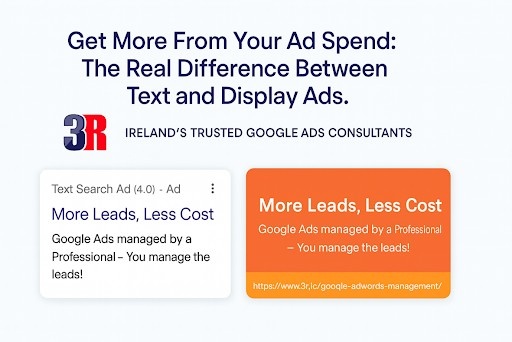
What Actually Determines the Cost of Google Ads, and Are Visual Ads More Expensive Than Text Ads?
Google Ads cost depends on competition, intent, ad format and landing page experience. Text search ads usually cost more per click due to high-intent audiences, while Display and Shopping ads offer lower CPCs but play different roles across awareness, discovery and conversion.
Google Ads costs are set by auction dynamics influenced by competition, expected click-through rate, and landing page experience. Because search ads target users actively looking for solutions, advertisers bid aggressively. This is why text CPCs skew higher—especially in high-value sectors.
2025 CPC Benchmarks Across Industries (Search Ads)
Industries with the highest commercial value show the highest CPC:
Search ads cost more where competition is intense and customer lifetime value is high.
How Visual Ads Compare
- Display CPC: typically around $0.63
- Shopping CPC: varies by sector but often $0.56–$0.89, far below search ads
- Video CPM/CPV: low-cost reach but dependent on creative
Summary:
Text = high cost, high intent
Visual = low cost, broad reach
Shopping = visual + intent + strong ROI
Which Industries Perform Best on Google Ads, and What Are Their 2025 Benchmarks?
Industries differ dramatically in Google Ads performance. Legal, auto and consumer services convert well, while tech and e-commerce convert lower. Shopping ads outperform text in retail with ROAS from 3.5× to 10×. Benchmarks for CPC, conversion rates and CPA vary widely by sector.
Google Ads Metrics – a Beginner’s FAQs
Before diving into the industry benchmarks, it’s important to understand what these numbers actually mean. Google Ads performance isn’t random — it’s shaped by how much a click costs, how well that click converts into a customer, and how expensive it is to acquire that customer in each industry.
Some sectors naturally convert better than others because people are ready to make quick decisions, while others take longer and cost more to advertise to. The following breakdown explains how each metric works so the industry charts make sense even if you’re new to paid advertising.
What is CPC — Cost Per Click?
How much you pay when someone clicks your ad. High CPC = a competitive sector or high-value customers.
What is CTR — Click-Through Rate?
The percentage of people who see your ad and actually click it. High CTR = strong relevance and compelling messaging.
What is CVR — Conversion Rate?
The percentage of clicks that turn into leads or sales. Higher CVR means your landing page, offer, and targeting are aligned.
What is CPA / CPL — Cost Per Action / Cost Per Lead?
The cost of generating a sale, enquiry, or meaningful action. Lower CPA = more efficient funnel; higher CPA = more expensive leads.
What is ROAS — Return on Ad Spend?
How much revenue you earn for every €1 spent on ads. – ROAS 5× means €1 becomes €5 in revenue.
What is the difference between B2B vs B2C?
- B2B: Longer decision cycles, higher CPA, lower CVR.
- B2C: Faster decisions, higher CVR, lower CPA.
Why do These PPC Metrics Matter?
Together, they reveal the full profitability path: CPC → CVR → CPA → ROAS
This sequence shows not just traffic cost, but how effectively that traffic becomes revenue.
Full Performance Breakdown
High-intent sectors (legal, auto, dating) convert strongly; research-heavy sectors (B2B, tech, e-commerce) convert lower.
2025 CPA Benchmarks (Search Ads)
High-value services > higher CPLs
Consumer goods > lower CPLs but require scaling efficiency
How Do Visual (Shopping/Display) Ads Perform Compared to Text Ads Across Industries?
Shopping and Display ads behave very differently from text search ads. Shopping ads often deliver higher ROAS and lower CPC thanks to product imagery and structured data, while text search ads deliver stronger CTR and CVR due to high-intent search behaviour. Each excels at different stages of the buying journey.
Full Comparison: Visual vs Text Ads
Visual formats such as Shopping and Display ads play a different role in the funnel compared to text-based search ads. Shopping ads often show exceptional ROAS in retail because users see the product, price and brand before clicking, reducing uncertainty and wasted clicks. Meanwhile, text search ads generally outperform in CTR and conversion rate because they capture users at the exact moment of intent.
To make this comparison clear, here is a direct performance benchmark table comparing Shopping Ads (visual) with Text Search Ads (plain text) across key metrics:
Shopping Ads vs Text Search Ads (2025 Benchmarks Across Industries)
|
Metric |
Shopping Ads (Visual) |
Text Search Ads (Plain Text) |
What This Means |
|---|---|---|---|
|
CTR (%) |
0.55 – 1.20 |
3.0 – 5.0 |
Text ads attract more clicks because they align with active search intent. |
|
CVR (%) |
1.1 – 2.8 |
2.8 – 6.0 |
Text ads convert better since users are already solution-aware. |
|
CPC (USD) |
0.56 – 0.89 |
2.50 – 4.00 |
Shopping ads are dramatically cheaper per click. |
|
ROAS (×) |
3.5 – 10.6 |
2.0 – 6.0 |
Shopping ads deliver outstanding profitability for retail. |
Why These Differences Matter
- Shopping Ads win on ROAS and CPC.
Retailers often scale profitably because Shopping ads provide “visual certainty” and filter out low-intent clicks. - Text Search Ads win on CTR and CVR.
They capture users actively searching for a specific service or solution, making them essential for B2B, services, and high-ticket industries. - Display Ads support both formats.
They rarely convert directly but play a powerful role in brand awareness and retargeting.
In simple terms:
Search ads find people who already know what they want.
Shopping ads persuade people visually and profitably at scale.
Do B2B and B2C Brands Perform Differently on Google Ads, and Which Ad Formats Work Best for Each?
Yes. B2B faces higher CPCs, lower CTR and longer buying cycles, making text search critical for leads. B2C benefits more from visual formats—Shopping, Display and Video—driving discovery, engagement and strong ROAS. Each sector requires a different strategy.
B2C Performance Patterns
Search Ads
- Stronger conversion rates due to fast decisions
- Lower CPCs than legal/B2B sectors
- Ideal for bottom-funnel sales
Visual Ads
- Shopping ads dominate retail ROAS
- Display/Video excel for inspiration, discovery and retargeting
B2C thrives when visual formats feed demand and search captures intent.
B2B Performance Patterns
Search Ads
- Lower conversion rates (~3.04%)
- Higher CPC because leads are valuable
- Essential for capturing explicit intent (“software demo”, “B2B supplier”, etc.)
Visual Ads
- Weak for direct response
- Excellent for retargeting and early-stage touchpoints
- Multi-touch attribution required to measure ROAS accurately
B2B thrives when search captures the hand-raisers and display/video maintain visibility across long buying cycles.
Which Format Typically Delivers the Highest ROAS Overall: Text or Visual?
Search ads deliver the highest direct ROAS in B2B and high-intent categories, while Shopping ads often deliver the highest ROAS in e-commerce and retail. Display supports awareness and retargeting but is rarely a direct ROAS driver.
ROAS Summary
- Search ROAS: Highest for B2B, legal, services
- Shopping ROAS: Highest for e-commerce and retail (3.5×–10×)
- Display ROAS: Strong indirect ROI; weak direct ROI
- Video ROAS: Context-dependent; strong when paired with retargeting
No single format wins everywhere. The winner depends on audience intent, industry economics, and creative clarity.
How Important Is Landing Page Design for Google Ads Performance and ROAS?
Landing pages are one of the strongest predictors of Google Ads success. They influence conversion rate, CPC, Quality Score and ROAS. Strong pages can double conversions and halve acquisition costs, while weak ones cripple even the best-targeted campaigns.
How Do Landing Pages Influence Every Profit Lever in Google Ads?
Landing pages have a greater impact on Google Ads performance than almost any other factor. They influence conversion rate, Quality Score, CPC, ad rank, trust, user behaviour and ultimately ROAS. Strong landing pages multiply results; weak ones destroy profitability.
1. How Does Landing Page Design Affect Conversion Rate?
Landing pages directly determine how many visitors convert into leads or customers. Even tiny improvements—like faster load speed, clearer messaging or easier forms—can increase conversion rates by 20%–200%. A well-designed landing page is the most powerful lever in Google Ads ROI.
Conversion Rate (CVR) is the percentage of visitors who take action—buy, book, call or submit a form. Landing pages influence CVR more than targeting, bidding or even ad creative.
Key performance multipliers:
- Page speed: A 0.1-second improvement can increase CVR by up to 12%.
- Clarity of message: Simplifying headlines and highlighting the value often produces a 50–200% lift.
- Mobile optimisation: Ensuring fast, scrollable, thumb-friendly layouts improves CVR by 20–50%.
- Form simplification: Removing unnecessary fields dramatically reduces abandonment rates.
If your landing page is confusing, slow or cluttered, no amount of ad spend can fix it.
If it’s fast, clear and persuasive, ads immediately become more profitable.
2. How Does Landing Page Experience Impact Google’s Quality Score?
Google evaluates landing pages for relevance, speed, mobile usability and trust. A strong landing page boosts Quality Score, which lowers CPC, improves ad rank and reduces acquisition costs. Poor landing pages increase ad costs even if the ads themselves are good.
Quality Score is Google’s internal measure of your ad and landing page relevance. It influences:
- CPC (Cost Per Click)
- Ad position (Ad Rank)
- How often your ads show
- Overall cost-efficiency
Google scores landing pages based on:
- Relevance to the keyword and ad text
- User experience (navigation, clarity, layout)
- Page speed and mobile performance
- Transparency and trust signals
Better landing page experience yields:
- Lower CPC (Google rewards relevance with cheaper clicks)
- Higher Ad Rank (ads appear above competitors)
- Cheaper conversions (since CPC × CVR drives CPA)
Good landing pages don’t just convert better—they reduce your costs across the entire system.
3. Why Is Trust the Most Important Element on a Landing Page?
Visitors leave landing pages when they feel uncertain, overwhelmed or sceptical. Trust signals—clear messaging, social proof, testimonials, transparent pricing and clean design—can dramatically improve conversion rates. Without trust, even high-quality traffic will not convert.
Trust determines whether users stay or bounce within the first 3–5 seconds.
Most users leave landing pages because they:
- Don’t understand the offer
- Don’t trust the brand
- Don’t see evidence it works
- Feel overwhelmed by poor design or too much text
High-trust landing pages include:
- Clear value proposition (what it is, who it’s for, why it matters)
- Social proof (reviews, testimonials, case studies, logos)
- Transparency (pricing, next steps, privacy assurances)
- Simple, clean design that reduces cognitive load
Trust is not a “nice to have”—it is the gateway to conversion.
Without it, paid traffic leaks instantly.
Why do Landing Pages Make or Break Google Ads Performance?
Landing pages determine:
- Whether users stay
- Whether they trust
- Whether they understand
- Whether they convert
- Whether your costs go up or down
- Whether your ROAS is positive or negative
Ads buy traffic. Landing pages turn that traffic into revenue. Every profitable Google Ads campaign starts with a landing page that works.
How Does 3R’s Relevance–Reach–Results Framework Transform Google Ads Performance?
3R improves Google Ads and PPC by aligning intent (Relevance), optimising on-page attention (Reach) and maximising conversions (Results). This full-funnel method reduces CPC, increases ROAS and turns ad spend into predictable growth.
How Does Relevance Improve Google Ads Performance and Reduce Costs?
Relevance means aligning your ad, keyword and landing page message so the user sees exactly what they were searching for. High relevance improves Quality Score, increases CTR, boosts conversions and reduces CPC. Google rewards advertisers whose pages fulfil the user’s intent.
Relevance is the foundation of PPC performance because it ensures that what the user sees is exactly what they expect. When message match is strong, users click more, convert more, and Google lowers your cost.
What does Relevance mean in the Google Ads context?
- Headline matches the search term – The user must instantly recognise that they’re in the right place.
- Landing page matches the ad promise – Whatever the ad says must be delivered immediately above the fold.
- Offer matches user pain or desire – Ads and pages should speak directly to the reason they searched.
- Testimonials match the offer – Social proof must be specific to reinforce belief and reduce doubt.
When Relevance is strong, Google improves your Quality Score, meaning:
- Higher CTR
- Lower CPC
- Higher Ad Rank
- More conversions at a lower cost
Relevance makes your ads cheaper, more effective, and easier to scale.
How Does Reach Determine Whether Google Ads Traffic Engages or Bounces?
Reach refers to how effectively your landing page captures and holds user attention. Strong above-the-fold value, mobile-first design and clear visual hierarchy reduce bounce rates and increase engagement. Reach ensures paid traffic stays long enough to convert.
Reach is not about how many people see your ads — it’s about how many people stay after they click. This is where most PPC campaigns lose money. A user can click a perfectly targeted ad and still bounce if the page doesn’t immediately pull them in.
What should High-Reach landing pages include?
- Strong above-the-fold value – Users should understand the offer within 2–3 seconds.
- Mobile-first structure – Most PPC clicks are mobile; pages must scroll naturally and load instantly.
- Clear visual hierarchy – Users need a guided path for their eyes — headline → benefit → CTA.
- Scannable sections – Short paragraphs, bullets, bolding and whitespace increase comprehension.
- Proof before pitch – Show credibility early so visitors trust the offer.
When Reach is strong, engagement goes up, bounce rates fall, and conversions rise — even without changing the ad itself.
Reach is where attention turns into interest.
How Do Results Turn Google Ads Traffic Into Measurable Revenue?
Results are created when landing pages turn attention into action. Clear CTAs, clean forms, strong trust signals and fast load speed drastically improve conversion rates. Most campaigns fail not because of targeting, but because the conversion experience is broken.
Results are where revenue happens. You can have perfect targeting, strong relevance and high engagement, but if the conversion experience is weak, the entire funnel collapses. Most PPC campaigns “fail” here — not in the ad account.
What is required for Great Results?
- One primary CTA – Multiple options confuse visitors and lower conversions.
- Clean, simple forms – Ask only for what is necessary; every extra field reduces completion rates.
- Strong trust signals – Testimonials, reviews, guarantees, certifications and transparent language.
- Speed + clarity – Users convert when they instantly understand what they get and why it matters.
- CRO testing and iteration – Continual refinement improves CVR and lowers CPA month after month.
Most ads don’t fail because of inadequate keyword targeting — they fail because the conversion environment cannot support the traffic.
Results turn clicks into customers. Without them, everything else is wasted ad spend.
The Real Secret Behind High-Performing Google Ads
Google Ads isn’t just about buying traffic—it’s about turning that traffic into measurable, profitable growth.
The data is clear:
- CPC varies by industry economics
- Search captures intent
- Shopping wins retail
- Display fuels awareness
- B2B and B2C require different architectures
- Landing pages determine everything
- And 3R ensures the entire system works together
Businesses who scale aren’t spending more—they’re spending smarter.
Ready for Clarity and Growth?
Book a 15-Minute Vital Stats Call with 3R.
We’ll analyse your Google Ads, landing pages and sales funnel using the Relevance–Reach–Results methodology and show you exactly where growth is leaking—and how to fix it.
No fluff.
No sales pressure.
Just clarity.