Google AI Search for Cleaning Companies: Win Better Leads Without Wasted Clicks
August 7, 2026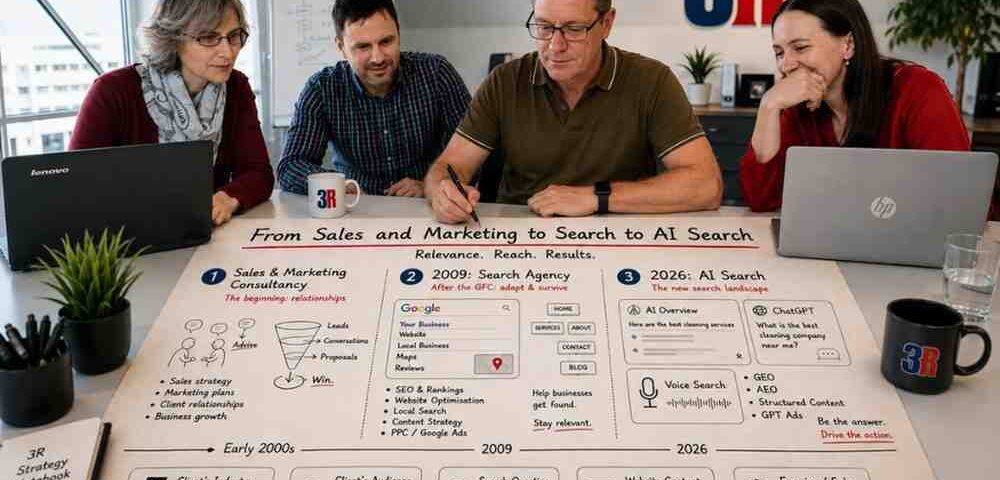
What Is Different About 3R as a Google AI Search agency?
3R is different because we use the same Google AI Search, SEO, AEO, GEO, content and website strategy to attract our own clients that we then build for them. The method is not theory first. It is a working system tested on our own business.
Most agencies say they can get you found. Fair enough. But a more useful question is: how did you find them?
3R became a search agency because someone rang us years ago and said, in effect, “We are not interested in your sales and marketing consultancy. We are interested in being top of Google, like you were when we searched for help.”
That call changed how we looked at the business. We had been talking about sales and marketing. The market was telling us something plainer. It wanted to know how to be found by the right people at the right time.
That is still the heart of 3R. We build our own website, articles, service pages, case studies and search journeys in the same way we recommend clients build theirs. If you found 3R through search, content, Google AI Search, an article, a service page or a practical answer to a problem, then you have already experienced part of the system.
The way you found 3R should become the way your next best customer finds you.
Why Did 3R Move From Sales and Marketing Consultancy to Search?
3R moved towards search because clients showed us what mattered most to them. They did not just want general marketing advice. They wanted to be found when their ideal customer was actively looking for help.
That shift was not a branding exercise. It was a commercial observation.
We had spent years helping businesses with sales, marketing, positioning, messaging and websites. All of that still matters. In fact, it matters more now. But search captures people at a particular moment: when they are trying to solve something.
A person searching for a Google Ads agency, a website designer, a search agency or help with AI Search is usually not browsing casually. Their leads may have slowed down. Their website may no longer be performing. Their Google Ads may have become too expensive. Their competitors may be showing up in places they are not.
The AI Search era has made those questions longer and less forgiving of vague answers. Someone may now search for “how do I stop my business disappearing from Google AI Search?” or “should I use Google Ads while building organic SEO?” or “what is the difference between SEO, AEO and GEO?”
If an agency cannot answer those questions on its own website, it is hard to see why a client should pay it to answer theirs.
What Is the 3R Framework and Why Does It Matter in AI Search?
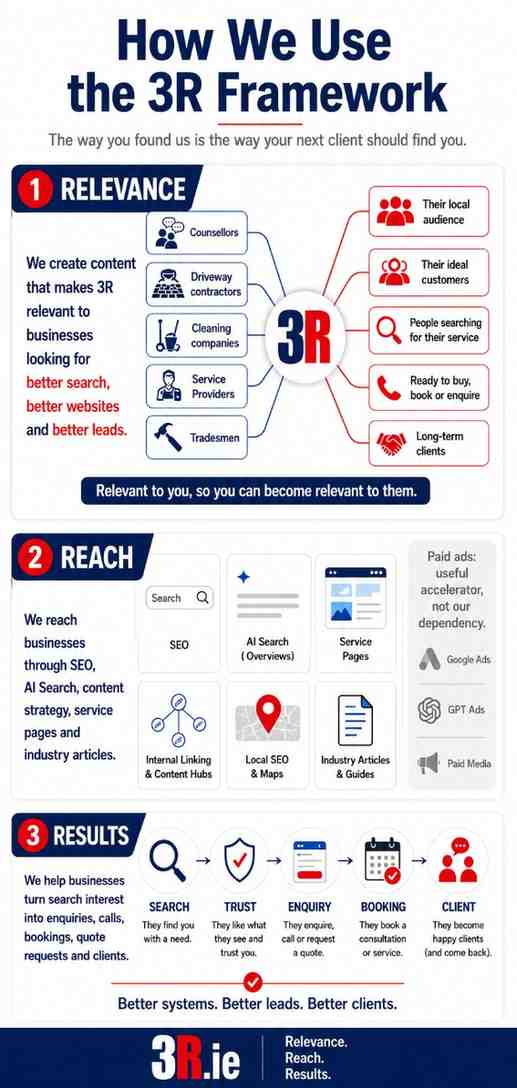
The 3R framework is Relevance, Reach and Results. It helps a business explain why it matters to the right audience, appear where that audience is searching, and turn attention into enquiries, calls, bookings, quote requests or sales.
The framework was not invented in a boardroom. Over time, the same pattern kept appearing in client work.
A business had to be relevant to the person searching, in the language and context that person actually used. It had to be reachable through the places where decisions were being shaped: Google, AI Search, maps, service pages, articles, ads, email, referrals and the website itself. Then the work had to produce commercial movement, not just impressions or rankings that looked tidy in a report.
For 3R, the framework is recursive, although the idea is simple enough. We make 3R relevant to business owners who are worried about search, leads, AI, Google Ads, websites and future visibility. We reach those business owners through our own content, SEO, AEO, GEO, Google visibility, service pages and industry articles. Then we use the same thinking to help those businesses become relevant to their own customers.
That is the practical test of the framework. It has to work on us before we can reasonably ask clients to trust it.
How Does Relevance Work for Online Marketing and Search Agencies?
Relevance starts when an agency stops describing services and starts answering the commercial problems clients actually have. A business owner does not wake up wanting “GEO”. They wake up worried that enquiries are falling and competitors are being found first.
Marketing agencies often lead with the language of the trade: SEO, PPC, AEO, GEO, conversion work, technical structure, content strategy and now AI Search. Some of those things matter. We use them ourselves. But they are not usually where the client starts.
The client starts with a business problem.
“My website is not bringing in leads.”
“My Google Ads spend is getting out of control.”
“My competitors are showing up everywhere.”
“We redesigned the site and traffic dropped.”
“People find us, but they do not enquire.”
“We do not know whether AI Search is going to damage us or help us.”
A Google AI Search agency has to translate between the client’s problem and the search system’s requirements.
For 3R, the category is not simply “digital marketing agency”. That is too broad and too crowded. A more useful position is being the search agency that helps businesses become relevant, findable and commercially useful in Google, AI Search and their own website journey.
It is not as neat as a three-word service label, but it is closer to how people actually buy.
How Does 3R Use Category Thinking Without Making It Academic?
3R uses category thinking by mapping the relationship between a business, its audience, the problem being searched, the language used, and the action required. The value is not in sounding clever. The value is in seeing what belongs together.
The practical questions are straightforward enough:
- What is the business?
- Who is the audience?
- What problem are they trying to solve?
- What language do they use before they know the answer?
- What proof do they need before they act?
- What action completes the journey?
A counsellor does not just need to rank for “counsellor near me”. They need to show the relationship between anxiety, trauma, grief, location, therapy type, trust and the first safe contact.
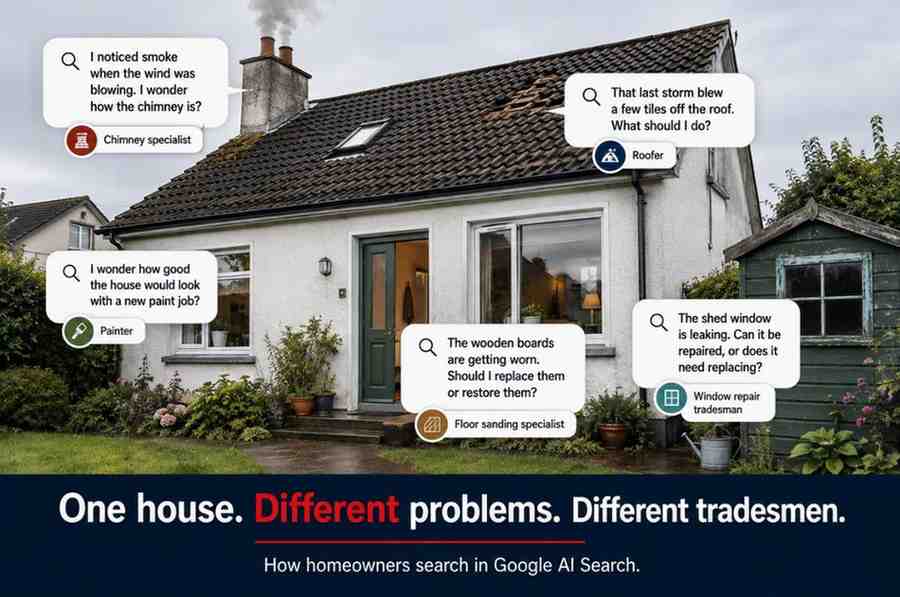
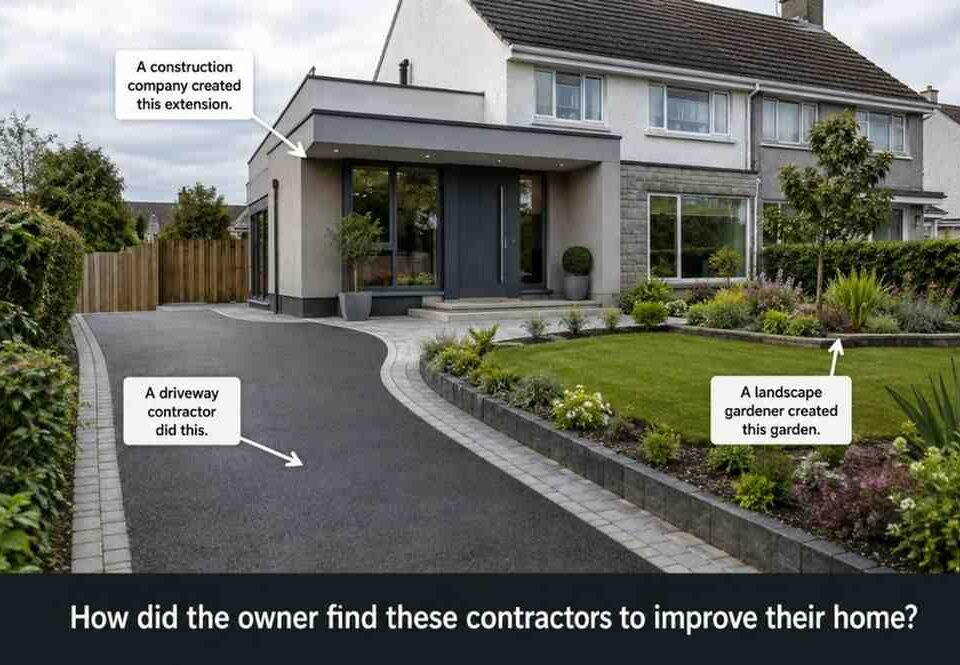
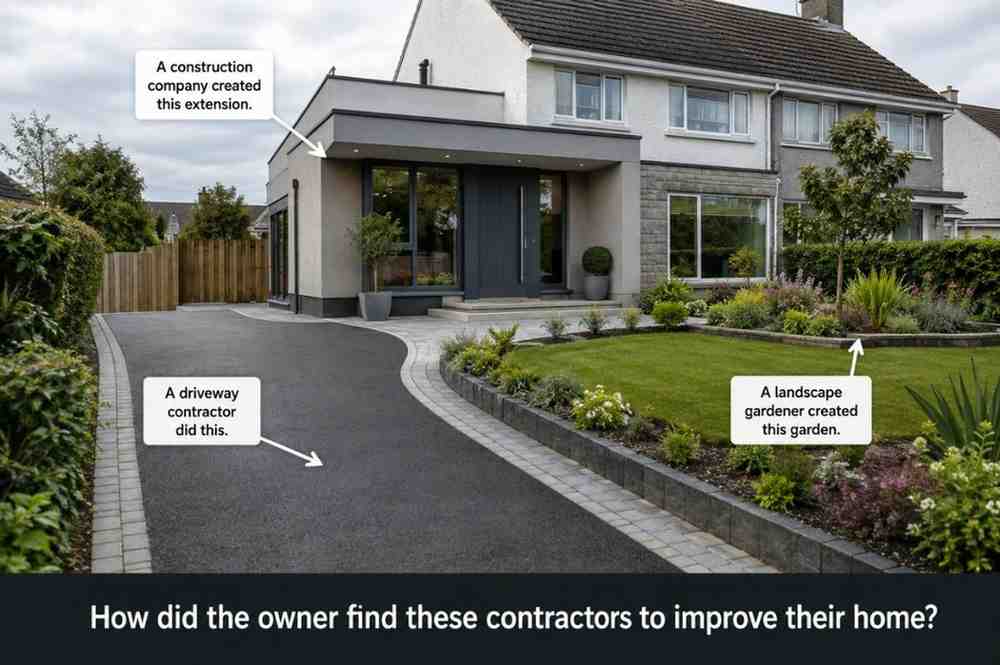
A driveway contractor does not just need “driveway contractor Dublin”. They need to show surface types, drainage, site access, finished work, quote routes and local credibility.
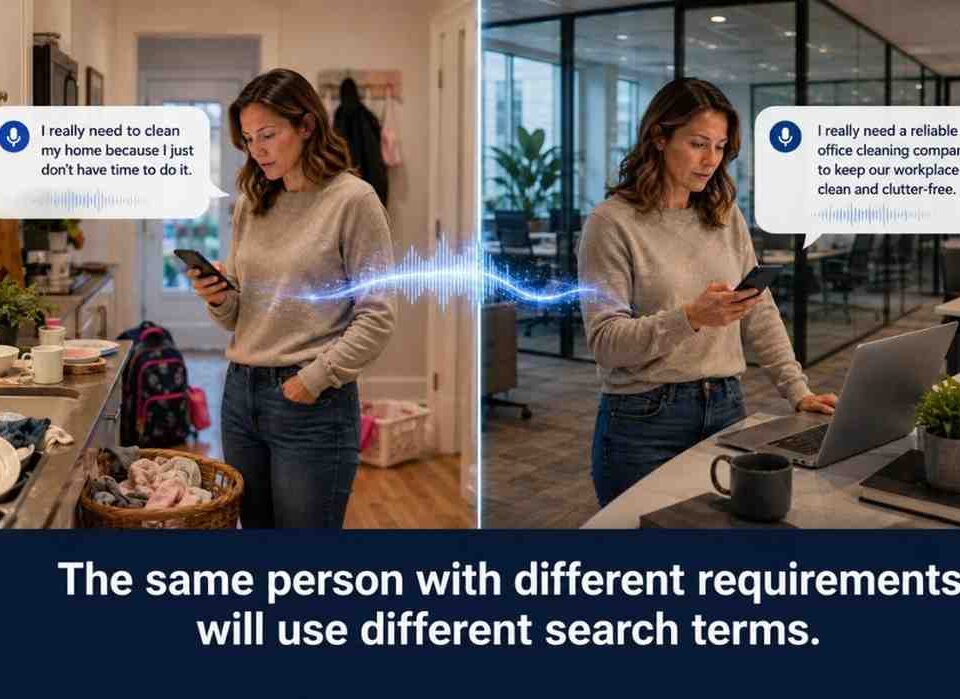
A cleaning company does not just need “cleaner near me”. Domestic cleaning, post-build cleaning, office cleaning, hospitality cleaning and medical cleaning all carry different expectations.
3R is no different. We are relevant to a business owner because we talk about the problem they are actually facing: disappearing from Google, losing leads, wasting ad spend, struggling to explain services, or not knowing how AI Search will affect them. Then we help that business do the same for its own audience.
How Does Reach Work for a Search Agency in the AI Era?
Reach is no longer just about publishing content and hoping Google ranks it. A search agency now has to make its expertise discoverable through Google Search, Google AI Search, AI Overviews, ChatGPT-style search, voice search, service pages, schema, internal links and paid media where appropriate.
We have used paid search ourselves in the past. When Google Ads first came out, we used them partly for reach and partly for learning. Ads showed us what people clicked, what they ignored, what language created action and which pages converted.
That was useful, but 3R does not rely on Google Ads for its own leads now. More than 20 years of SEO, content, website structure and search authority carry much of the work.
That is not a moral position. It is simply where a mature organic search system should get to.
For newer websites, weaker domains or highly competitive sectors, Google Ads, Bing Ads, social ads or future GPT Ads may still be useful. They can create reach while SEO matures and they can test demand before the organic strategy has had time to build.
The mistake is treating paid media as the whole strategy. Ads can bring people to a page. They cannot make a vague proposition clear, fix weak proof or turn a poor enquiry journey into a good one.
How Should Website Designers Think About Google AI Search?
Website designers need to stop treating websites as visual brochures. In Google AI Search, a website must explain the business, structure the services, support the search journey and give users a clear reason to enquire.
A website can look good and still fail commercially. We have seen that plenty of times.
The homepage is polished. The images are attractive. The navigation is tidy. The copy says the business is professional, experienced, trusted and client-focused. Yet very little happens because the website does not explain the business in a way searchers, Google or AI systems can use.
A good website has to answer practical questions:
- What does the business do?
- Who is it for?
- What problems does it solve?
- Where does it operate?
- What proof supports it?
- What should the visitor do next?
That is why 3R’s own website redesign matters. The future 3R site should not simply have better pages. It should have better relationships between pages.
The “Industries We Serve” section should connect to industry landing pages. Those pages should connect to articles. The articles should connect to service pages, testimonials, case studies and audits. The pillar articles should hold the broader argument together.
A visitor should be able to land on a page about their industry, understand the search problem, see proof, find the relevant service and take a sensible next step without having to piece the whole thing together themselves.
How Should Google Ads and GPT Ads Providers Position Themselves Now?
Google Ads and GPT Ads providers should position paid media as part of a search system, not as a standalone fix. Ads can create reach quickly, but they work best when the landing page, category, message and enquiry route are properly aligned.
A campaign may be technically competent. The bidding may be fine. The keywords may be sensible. But if the landing page is too vague, the offer is unclear or the enquiry form asks for too little useful information, the business ends up paying for weak enquiries.
A cleaning company gets domestic enquiries when it wants office contracts. A contractor gets calls from outside its service area. A consultant gets low-quality leads who do not understand the service.
That is not always an ads problem. Often, it is a relevance problem.
GPT Ads, when they become part of the normal buying landscape, may make this sharper. If someone asks an AI system for help choosing a provider, businesses with clearer category signals, better proof and more useful fulfilment pages will have an advantage.
For 3R, paid media sits inside the wider search system. It can help a business learn, test and create momentum, but it should not be used to hide a weak website or unclear proposition.
How Does Results Thinking Change the Role of an Agency?
Results thinking changes the agency’s role from producing activity to creating commercial movement. Traffic, rankings, impressions and clicks matter only when they help produce better enquiries, better customers and better sales conversations.
We are mildly sceptical of a lot of marketing reporting. A client does not really want more graphs. They want to know whether the work is making the business easier to find, easier to trust and easier to buy from.
For 3R, results are not a decoration added at the end of a campaign. They affect the structure from the start.
If the goal is better counselling enquiries, the website has to make the first contact feel safe. If the goal is more driveway quotes, the website has to let people share location, photos, access details and rough timelines. If the goal is better cleaning contracts, the website has to separate domestic, commercial, post-build, hospitality and medical cleaning properly.
The same logic applies to 3R. If we want to attract businesses that need serious help with Google AI Search, SEO, AEO, GEO, websites and future search visibility, our own content has to filter properly. It should attract business owners who understand that search is not a trick, and it may also discourage people looking for a quick shortcut.
That is not a bad thing. Better-fit enquiries are usually worth more than busy inboxes.
How Is 3R Applying This to Its Own Website?
3R is applying this to its own website by developing it as a connected system rather than a collection of isolated service pages. Industry articles should lead naturally to relevant service pages. Service pages should connect to proof, case studies and testimonials. Pillar articles should help readers understand the wider argument before they decide what action to take.
This approach suits how business owners actually move through a website. Someone may arrive through an article about cleaning companies, counselling practices or driveway contractors. From there, they should be able to see how the issue connects to SEO, Google AI Search, website structure, paid media, testimonials and an audit or strategy session.
The site should not force everyone down the same route. A counsellor, a contractor and an ecommerce business may all need help with search, but they do not experience the problem in the same way.
The main AI Search pillar article explains the bigger shift behind this series:
This article is part of the same system. It shows how the method applies to 3R itself.
How Can 3R Use Its Own Content as Working Proof?
3R can use its own content as working proof by showing how each article, landing page and service page is built to attract the right searcher, answer the right question and create a clear next step. The content becomes both marketing and evidence.
Every article in the industry series does two jobs. It teaches the reader how Google AI Search affects their sector, and it demonstrates how 3R thinks.
The counselling article shows that search can be emotional, local and trust-led. The driveway and construction article shows how project details, photos, quote notes and site conditions can become useful search content. The cleaning article shows why categories matter, because domestic, post-build, commercial, hospitality and medical cleaning are different buying decisions.
This article does the same for search agencies, Google Ads providers, GPT Ads providers and website designers. We are applying the framework to ourselves in public.
That is useful for clients, but it is useful internally too. It shows where pages are missing, where proof should sit closer to the argument and where service language needs to become more practical.
A good content strategy should make the business sharper, not just busier.
What Should Search Agencies Do Now to Prepare for AI Search?
Search agencies should start by improving their own website before telling clients what to do. If an agency claims expertise in Google AI Search, its own site should show clear categories, useful content, strong internal links, proof and practical enquiry routes.
The first step is to stop hiding behind service labels. A page called “SEO” is rarely enough now. The page has to explain who the service is for, what problem it solves, how it connects to AI Search, what proof supports it and what the next step looks like.
The second step is to build industry depth. One article about AI Search is not a strategy. A connected series of industry articles, landing pages, service pages and case studies is far stronger because it shows how search changes by sector.
The third step is to improve fulfilment. AI can summarise what SEO is. It can explain AEO and GEO. It can compare paid media channels. It cannot audit your website, understand your category, diagnose lead quality or decide what your next commercial priority should be.
For 3R, that means the Relational Strategy Session and AI Search Visibility Audit need to be easy to understand, easy to request and clearly connected to the problems discussed across the site.
Why Should Clients Trust an Agency That Applies Its Own Medicine?
Clients should trust an agency that applies its own medicine because the agency’s own visibility becomes a live demonstration of its thinking. If the system helped you find and assess 3R, you can judge the work before a sales conversation ever begins.
This does not mean every client needs to copy 3R exactly. A counsellor does not need the same structure as a driveway contractor. A cleaning company does not need the same content as a software firm. A manufacturer does not need to sound like a marketing agency.
The principle is shared, but the detail changes by category.
A client can see the logic because they have already experienced it. They searched for help, found a relevant answer, read enough to understand the approach, and then decided whether 3R was worth speaking to.
That journey is more convincing than a promise on a services page.
What FAQs Do Businesses Ask About 3R and Google AI Search?
What Is a Google AI Search agency?
A Google AI Search agency helps businesses become easier to understand and find in AI-influenced search results, including Google AI Overviews, ChatGPT-style search, voice search and traditional organic search. The work still depends on clear services, useful content, sound website structure and commercial proof.
How Does 3R Use Its Own Framework?
3R uses Relevance, Reach and Results on its own website before applying the same thinking to clients. We create content that makes us relevant to business owners, reach them through search and website structure, then help them do the same with their own customers.
Does 3R Still Use Google Ads for Itself?
No, not as a core lead source. 3R used Google Ads in the past to learn what people searched for and how they responded, but more than 20 years of SEO and content now carry much of the work.
Should Clients Still Use Google Ads or GPT Ads?
In many cases, yes. Paid media can help while SEO matures, especially for newer websites or competitive sectors. The important thing is that ads send people to relevant pages that can turn interest into proper enquiries.
Why Does Category Thinking Matter in AI Search?
Category thinking helps connect the business, the audience, the search question and the action required. AI Search needs those relationships to be clear, and customers need them to be clear as well.
Can Smaller Businesses Compete in Google AI Search?
Yes, especially when they can show real experience. Smaller firms often have close knowledge of customer problems, local markets and practical service delivery, but that knowledge needs to be visible on the website.
Can 3R Help Your Business Apply the Same System?
Yes. 3R helps businesses apply the same system we use ourselves: become relevant to the right audience, reach them through search and website structure, and turn that interest into better enquiries.
AI Search will change how people compare agencies, trades, professional services and products. It does not remove the need for clear communication, practical proof and a website that knows what job it is meant to do.
The Relational Strategy Session looks at the relationship between your business, your audience and the search systems connecting the two.
The AI Search Visibility Audit is more specific. It looks at where your website is weak, where Google or AI systems may struggle to understand you, where your content is too thin, and where enquiries may be leaking.
If your website, content and search structure are not doing their job, we can help you see where the gaps are and what should be fixed first.