Does Content Really Matter for SEO? These 16 Articles Prove It Absolutely Does!
October 26, 2025
The 12 Days of Christmas for Your Website
December 10, 2025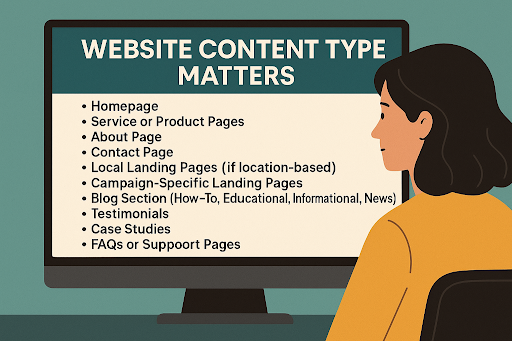
A Plain-English Guide to Writing Website Copy That Delivers Relevance, Reach, and Results
This guide walks you through every essential page your website needs — from home and product pages to testimonials and blogs. You’ll also learn how to write content that works with Google, AI, and your audience.
We’ll explain how to use structured data, how AI can help (and where humans are still essential), and the psychology behind persuasive, conversion-focused writing. Whether you’re building a new site or updating an old one, this article gives you a step-by-step look at what to write, why it matters, and how to make it work.
What Makes Website Content Work in 2025?
Great website content helps people and earns attention. In 2025, it needs to be clear, helpful, persuasive, and structured for search engines and AI tools. It must connect with people and perform online.
- Why is website content more important now than ever before?
Because it’s how people (and search engines) judge you. If your content doesn’t answer questions, prove trust, and guide users clearly, you’ll lose traffic and conversions.
- What does ‘Relevance, Reach, Results’ mean for content?
Relevance means the content matches what your customer needs. Reach means it shows up when they’re searching. Results mean it turns visitors into leads or buyers.
- How has content changed over the years?
We’ve moved from keyword stuffing to helpful, well-structured content that’s easy for AI to parse and humans to read. Now, writing for people and machines is the norm.
Today, content isn’t just about writing — it’s about solving problems, earning attention, and giving your business a voice that works 24/7.
What Pages Should Every Business Website Have?
Your website should guide visitors clearly — from first impression to final action. That means having the right pages in place and making each one count.
What are the core types of pages a business website should include?
At a minimum, your website should have:
- Homepage
- Service or Product Pages
- About Page
- Contact Page
- Local Landing Pages (if location-based)
- Campaign-Specific Landing Pages (SEO Audit)
- Blog Section (How-To, Educational, Informational, News)
- Testimonials
- Case Studies
- FAQs or Support Pages
Each of these serves a purpose in guiding users through your sales funnel, from awareness to conversion.
What makes a good homepage?
A great homepage instantly tells people who you are, what you offer, and why they should care. It should highlight your main services, direct users to deeper pages, and establish credibility at a glance.
What should a service or product page include?
Service and product pages must explain benefits, answer objections, and invite action. Use clear subheadings, bullet points, FAQs, trust signals, and relevant imagery or video. Focus on what’s in it for the customer.
Why is your About Us page so important?
People buy from people. A strong About page builds trust by sharing your story, your team, your mission, and what makes your company different. It should feel human, not corporate.
What does a great contact page need?
Make it ridiculously easy to get in touch. Include a contact form, phone number, email address, and Google Map if you’re local. Consider including business hours, response time, and social media links.
Why do you need local landing pages for SEO?
If you serve different towns, cities, or regions, Google rewards pages that are tailored to each location. These pages should include location-specific keywords, testimonials, maps, directions, and service details.
When should you create campaign landing pages?
Use these for Google Ads, social ads, or email marketing. Unlike normal pages, they should remove distractions (like menus) and lead users to a single action — sign up, book, or buy.
Why are blog articles essential for your website?
Blogs help you attract people who are still researching or learning. They boost SEO by targeting long-tail keywords and give you content to share on social media and email newsletters.
What kinds of blog content work best?
- How-to Guides: Answer step-by-step queries your customers are Googling.
- Educational Posts: Help people understand what you do and why it matters.
- News & Updates: Share industry trends or company announcements.
- Opinion or Expert Pieces: Position yourself as a thought leader.
- Listicles or Comparisons: Easily digestible formats that solve a problem.
How do testimonials help your site?
They build social proof. Visitors trust what other customers say about you more than your own claims. Include names, photos, and specific outcomes when possible.
Why are case studies powerful?
They show potential customers that you can deliver. Case studies tell a story of a real client who faced a problem, worked with you, and achieved success.
How should you structure a case study?
Follow a proven flow: Challenge → Solution → Result. Include metrics (if available), customer quotes, and before/after visuals.
These aren’t just boxes to tick. Each page plays a role in your visitor’s journey. When built with care, they guide, persuade, and convert — doing the hard work even when you’re offline.
How Do You Write Content That Google (and AI) Understand?
Search engines and AI assistants don’t just read your words — they try to understand them. That means your content needs to be clear, structured, and machine-readable. The goal is to help both humans and algorithms navigate, comprehend, and surface your message.
What is schema markup and how does it help?
Schema markup is structured code added to your website that labels content — like products, reviews, FAQs, or services. It helps Google and AI tools understand the context of your content and display it in richer formats.
What are rich snippets and why do they matter?
Rich snippets are enhanced search results that include extra information like star ratings, pricing, FAQs, or availability. They make your listing more visible and clickable — often leading to better CTRs and more qualified traffic.
How can schema improve visibility in search and AI tools?
Schema helps your content appear in featured snippets, Google’s AI-generated overviews, and voice assistant results. It increases the chances that your content gets shown in the right place, at the right time, to the right user.
Why is content structure important for SEO and AI?
Clear formatting — such as proper use of H1, H2, and H3 headings, short paragraphs, bullet points, and question-and-answer sections — makes it easier for both humans and algorithms to scan, understand, and rank your content.
How does content structure support voice and AI search?
AI agents like Siri, Alexa, and ChatGPT favour well-structured content with concise answers. Using natural, conversational language and directly answering “what”, “why”, and “how” questions helps your content perform better in voice results.
Why is it important to write how people speak?
People search with voice differently than with text — often using full questions or everyday language. Writing in a natural tone and mirroring how people actually talk improves both usability and discoverability.
Think of schema and structure as a translation layer between your content and the machines trying to serve it. When your content is well-formatted and semantically clear, it has a better chance of appearing in rich results, featured snippets, and AI summaries — putting your message in front of more of the right people.
How Do You Use AI Tools and GPTs to Create Better Content?
AI tools, like GPTs, can speed up writing — but only when guided by experts. At 3R, we train AI to follow proven writing formulas, not just generate fluff.
What is a custom GPT?
It’s an AI writing assistant trained on your brand voice, tone, target audience, and proven SEO structure. It helps us create consistent, high-quality content fast.
How does AI support keyword research and structure?
AI can analyse search trends and competitor pages to help suggest headings, keywords, and subtopics that your audience is searching for.
Why do humans still need to edit AI content?
AI writes fast, but it lacks judgement. Human editors refine tone, verify facts, and ensure emotional clarity and accuracy.
What are the benefits of using AI + human creativity?
Faster content creation, more consistency, scalable tone of voice, and less writer’s block — all while keeping the human touch.
When AI is used smartly, it becomes a time-saving tool — not a shortcut for poor writing.
What Makes Copy Persuasive Instead of Just Informative?
Persuasive content connects logic to emotion. It shows value, earns trust, and makes the next step easy.
How do you build trust in your writing?
By being clear, honest, and relatable. Show real results. Use testimonials and case studies. Avoid jargon.
What psychological triggers help drive action?
- Scarcity (limited-time offers)
- Authority (expertise or awards)
- Social proof (reviews and client logos)
- Clarity (one message per page)
Why should persuasive copy still feel natural?
Because no one likes to be sold to. Helpful, authentic writing that guides decisions works far better than pushy sales talk.
Writing that moves people to act is built on psychology, structure, and empathy — not hype.
Why Is Storytelling Important in Copywriting?
Stories stick. They create emotional connection and help people imagine themselves solving a problem with your product or service. Great storytelling turns abstract ideas into memorable, relatable experiences — and it makes your brand feel human.
Why does storytelling work better than facts alone?
Because we’re wired for stories. Neuroscience shows that stories activate more parts of the brain than data does. They help people visualise outcomes, connect emotionally, and retain information longer than dry statistics or features.
How can you use storytelling on your website?
You can weave stories into product descriptions (“Meet Sarah, who cut her admin time in half…”), case studies (“They were stuck, then we stepped in…”), About pages (“It started with a question we couldn’t ignore…”), or even blog articles like this one.
How was storytelling used in this article?
This guide was written using a real-life, behind-the-scenes narrative. We didn’t just list SEO tips — we walked through the process of writing the article itself: step-by-step structure, GPT assistance, rewrites, schema embedding, client-style edits, and content optimisation. By doing so, we not only explain best practices — we show them in action.
How can stories persuade without sounding salesy?
Instead of saying “our tool is fast,” show someone using it to save their Friday night. Instead of claiming “our service grows businesses,” tell the story of one who hired you, and what changed for them. This builds trust and makes claims feel credible.
Whether you’re writing an About page or an Google Ads landing page, storytelling gives your content soul. When readers see themselves in your words — their frustrations, their hopes, their goals — they stop scanning and start paying attention. That’s when copy starts to convert.
How Do You Measure Whether Website Content Is Working?
Good content earns attention and drives results. If it’s not getting leads or engagement, it’s time to improve or replace it.
What metrics show content performance?
Look at traffic, bounce rate, time on page, conversions, form submissions, or product clicks.
What tools help track performance?
Google Analytics (GA4), Google Search Console, Hotjar, Microsoft Clarity, and CRM data can all show how content supports your goals.
How do you link content to sales or leads?
Use goals in GA4, track form fills by page, and connect user journeys to CRM entries or call tracking.
Why is it important to update content regularly?
Because things change — your offers, your market, your tech. Fresh content performs better and shows your site is active.
Measuring what matters helps you write smarter next time — and waste less time guessing.
Frequently Asked Questions About Website Content
These are the most common questions clients ask when planning or improving website content.
Should I use AI to write my content?
Yes, but only with human guidance. AI helps with speed and structure, but people still write best for people.
How long should a service or blog page be?
As long as it needs to be helpful. 600–1200 words is a healthy guide. Use clear headings, visuals, and links to break up longer pages.
What content helps most with local SEO?
Location pages, local testimonials, and Google Business profile alignment. Mention place names naturally and add schema.
How often should I update website content?
Aim to review core pages yearly and update blog posts every 6–12 months — or sooner if facts change.
Can I rank without blogging?
Yes — but it’s harder. Blog content gives you more keywords to target and keeps your site fresh in Google’s eyes.
How can I make my brand sound more human?
Write how you speak. Use “you” more than “we.” Tell stories. Be real.
Want Content That’s Built to Rank and Convert?
Your website deserves better than filler copy. At 3R, we use proven methods, AI support, and human creativity to create content that earns traffic and trust.
Take the next step:
- Learn more about our SEO content services
- Request a free website content review
- Talk to our team — no sales pressure, just smart advice